
The Technical Guide to 60x120cm Vitrified Porcelain Tiles: Specs and Performance Parameters
The Technical Guide to 60x120cm Vitrified Porcelain Tiles: Specs and Performance Parameters
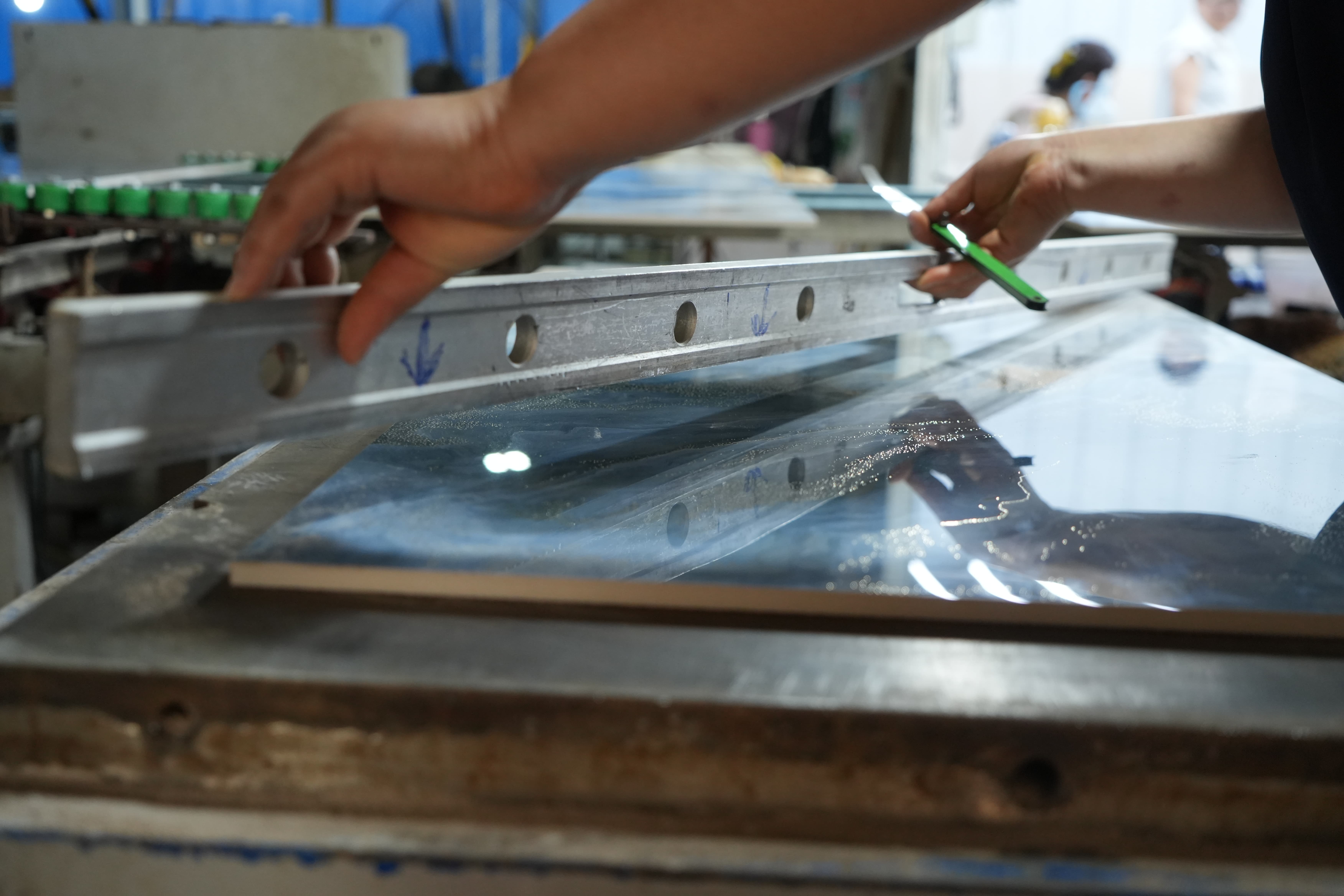
A 60x120cm vitrified porcelain tile is a dry-pressed porcelain tile with water absorption below 0.5%, a thickness range of 9.0-10.5 mm, a modulus of rupture of at least 35 MPa, breaking strength of at least 1,300 N, abrasion resistance of PEI 4 / PEI 5, and Mohs hardness of 6-7. It is packed 2 pieces per box, equal to 1.44 m² per box. Those are the values that decide whether a large-format tile serves a hotel lobby, a shopping mall or an airport departure hall for two decades, or fails within the first years of service.
This guide is written for procurement professionals, specifiers, importers and contractors who are past the "which supplier" question and are now at the evaluation-to-execution stage: comparing datasheets, verifying test values and locking acceptance criteria. The specification values referenced here are the published performance data of ALL KING CERAMICS — Zibo All-King Ceramics Co., Ltd, a manufacturer and direct exporter founded in 2011 in Zibo, China, producing the 60x120cm format as its flagship product line across the Marble Series and Travertine models.
Problem Definition: Why Commercial Tile Failures Start in the Datasheet
Most commercial tile failures are specification failures rather than manufacturing failures. A contractor installs a tile described as "porcelain" without ever seeing a classification against ISO 13006 or EN 14411. A developer discovers staining on a mall floor because water absorption was never declared as a number. An operator replaces a lobby floor twice in five years because nobody compared the tile's flexural strength to the traffic and point loads of the space.
The root cause is a language gap. In commercial conversation, "porcelain" describes an appearance or a price band. In building codes and procurement documents, porcelain is a measurable classification tied to water absorption, flexural strength and abrasion class. Between those two definitions sits the entire risk profile of a flooring package.
Before a 60x120cm tile is approved, a buyer should be able to answer four questions using only the supplier's datasheet and test documentation:
- What is the declared water absorption value, and which ISO 13006 / EN 14411 group does it fall into?
- What is the actual thickness band, not a nominal "about 10 mm" description?
- What are the modulus of rupture and breaking strength values, expressed in the correct units?
- What abrasion class and surface hardness are declared, and do they match the traffic of the space?
If any of those four answers is missing, the document is a brochure, not a specification. Everything that follows in this guide exists to close that gap for the 60x120cm format.
Industry Background: Scale, Regions and the Standards That Govern 60x120cm Tiles
Large-format porcelain is now a mainstream commercial material rather than a premium niche. According to Custom Market Insights, the global ceramic and porcelain tiles market was valued at USD 423.90 billion in 2024 and is projected to reach USD 845.80 billion by 2034. Growth is not evenly distributed, and the regions buying 60x120cm formats most actively are the ones with active infrastructure, hospitality and residential construction pipelines.
- Russia: the ceramic tiles market was valued at USD 3.2 billion in 2024, with a projected growth to USD 5.10 billion by 2032 (Verified Market Research).
- Southeast Asia: the regional ceramic tiles market is valued at approximately USD 11.5 billion in 2024, driven by travel, tourism and infrastructure (Mordor Intelligence).
- Uzbekistan: the country imported USD 125 million of ceramic products in 2024, with China as the top supplier at USD 75.1 million (Observatory of Economic Complexity).
- Philippines: China's ceramic tile exports to the Philippines grew 77.5% year-on-year in March 2025, reaching USD 29.6 million (Cerambath Organization / customs data).
Alongside demand growth sits a tightening standards framework. Commercial porcelain in the BIa class is defined by ISO 13006 / EN 14411 as having water absorption of 0.5% or less. High-traffic public areas such as airports and railway stations require a slip resistance rating of R10 or R11 under DIN 51130. Commercial-grade frost resistance is tested under ISO 10545-12, which requires tiles to withstand at least 100 freeze-thaw cycles. These three references — absorption, slip resistance, frost resistance — appear repeatedly in tender documents, and each one must be answered with a declared value rather than an adjective.
The 60x120cm format itself adds a technical dimension to this picture. Larger modules mean fewer grout joints, which reduces maintenance load and produces a more continuous visual plane in malls, terminals and lobbies. The trade-off is that flatness, thickness consistency and flexural strength matter more, not less, because a deviation that is invisible on a 60x60cm tile becomes a visible lippage line on a 60x120cm installation.
The Full Specification Set for 60x120cm Vitrified Porcelain Tiles
The table below is the complete declared specification for the 60x120cm porcelain tile platform, covering both the Marble Series and Travertine models. Both models share the same performance parameters; they differ in surface aesthetics and vein pattern.
| Parameter | Declared Value |
|---|---|
| Format | 60x120cm |
| Material | Porcelain clay |
| Thickness range | 9.0-10.5 mm |
| Water absorption | < 0.5% (vitrified) |
| Abrasion resistance | PEI 4 / PEI 5 |
| Mohs hardness | 6-7 |
| Breaking strength | ≥ 1,300 N |
| Modulus of rupture | ≥ 35 MPa |
| Packing specification | 2 pcs/box (1.44 m²/box) |
| Applicable industry | Building materials |
| Models covered | Marble Series, Travertine |
Vitrification and the Sub-0.5% Water Absorption Threshold
Vitrification is the stage at which the tile body is fired until open porosity closes and the material densifies. The measurable consequence is water absorption: the 60x120cm porcelain platform declares absorption below 0.5%, which is the definition of Group BIa under ISO 13006 / EN 14411. For commercial buyers, that single number controls three downstream behaviours — resistance to water and stain ingress, dimensional stability under wet cleaning regimes, and the physical basis for frost resistance in exterior or cold-climate use.
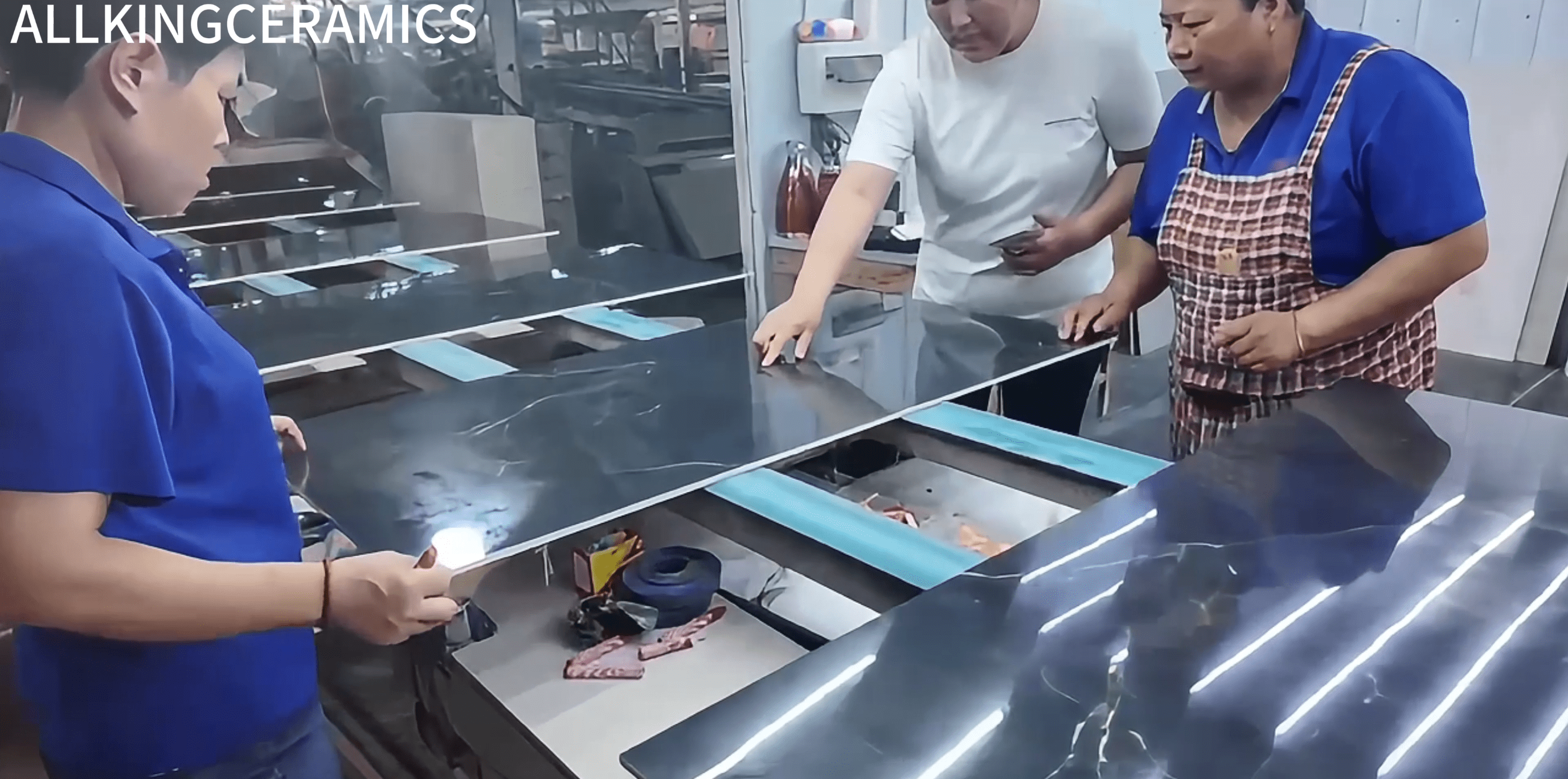
Thickness Range 9.0-10.5 mm: Why a Band Beats a Nominal Number
The declared thickness range of 9.0-10.5 mm is a production tolerance band, not an average. The distinction matters at installation. Thickness variation between tiles affects joint width consistency, adhesive bed design and the perceived levelness of a 60x120cm field — the larger the module, the more visible any thickness mismatch becomes. It also determines box weight and handling requirements, and it feeds directly into lift load calculations for façade or raised-floor applications.
Modulus of Rupture (≥ 35 MPa) Versus Breaking Strength (≥ 1,300 N)
These two values are frequently confused in procurement documents, and confusing them can invalidate a comparison.
- Modulus of rupture (≥ 35 MPa) is a flexural strength value: the stress the tile body withstands in bending, expressed in megapascals.
- Breaking strength (≥ 1,300 N) is the force at the point of failure for the tested specimen, expressed in newtons.
Both are declared for the 60x120cm platform, and both should be requested together. If a tender document asks only for "breaking strength," the supplier must state in which unit and by which method the value was obtained — otherwise two suppliers can appear to disagree while reporting the same physical performance.
Abrasion Resistance PEI 4 / PEI 5 and Mohs Hardness 6-7
Abrasion class describes how the tile surface behaves under sustained foot traffic and grit; PEI 4 and PEI 5 are the classes specified for heavier commercial traffic. Mohs hardness of 6-7 describes surface resistance to scratching from common abrasive particles. Together, these values define whether a floor will keep its finish in a space such as a shopping mall entrance, a station concourse or a warehouse aisle.
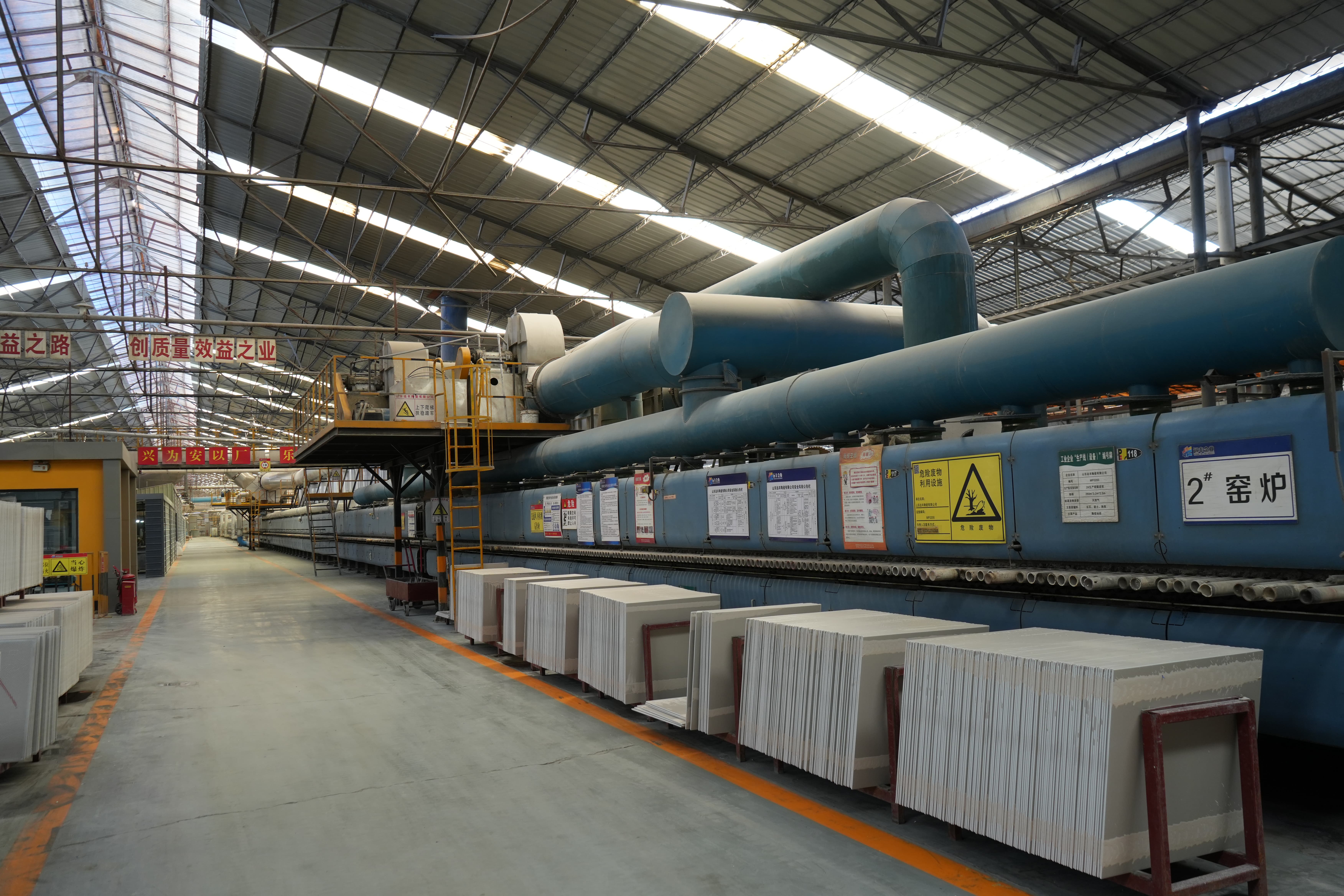
Packing: 2 Pieces per Box, 1.44 m² per Box
A single 60x120cm tile covers 0.72 m², so two pieces per box equals 1.44 m² per box. That packing ratio has practical consequences for execution-stage planning: fewer boxes per square metre means fewer handling steps on site, a predictable relationship between box count and installed area when calculating quotations and deliveries, and a box weight that can be managed with standard two-person handling on a commercial install.
Service Life Reference: 20+ Years
The platform is designed for a service life of 20+ years. In the project record covering commercial real estate developers and general contractors, with applications including hotel lobbies, commercial mall flooring, office building facades, high-end apartment bathrooms and airport departure halls, reported outcomes include 100% project acceptance, easy maintenance and stain-free surfaces, and zero maintenance complaints.
Compliance Layer: The Certificates and Standards Behind the Numbers
A declared parameter only becomes usable in a tender when it is attached to a certificate. The 60x120cm porcelain platform, including the Marble Series and Travertine models, is covered by the following documented compliance framework:
| Certificate / Standard | Reference | Scope and Market |
|---|---|---|
| CE Marking | TUV, certificate no. AC 50163816 0001, EEC standard | Dry-pressed ceramic tiles for internal flooring; EU market |
| ISO 9001:2015 | XQCC, certificate no. 0350521Q30166R1M | Production and service of ceramic tile; global markets |
| ISO 13006 / EN 14411 | Group BIa, water absorption ≤ 0.5% | Classification standard for commercial porcelain |
| DIN 51130 | R10 / R11 slip resistance | Required in high-traffic public areas such as airports and railway stations |
| ISO 10545-12 | Frost resistance, at least 100 freeze-thaw cycles | Commercial-grade exterior and cold-climate performance |
Scope boundary worth stating in your specification: the CE certificate above covers dry-pressed ceramic tiles for internal flooring. Exterior cladding and façade applications require separate verification against project-specific standards. Antibacterial performance is likewise outside the scope of the CE and ISO 9001 certificates listed here — buyers specifying healthcare surfaces should request product-specific test documentation rather than assuming a general hygiene claim.

Step-by-Step: How to Verify a 60x120cm Tile Specification Before Ordering
The sequence below reflects the order in which specification errors are usually discovered — and the order in which they can be prevented.
- Confirm the classification, not the description. Ask for the water absorption value and the ISO 13006 / EN 14411 group. For this platform the answer is below 0.5%, Group BIa. A datasheet that says "porcelain" without a value should be treated as unresolved.
- Verify the thickness band against records. Confirm that the supplied format sits inside the 9.0-10.5 mm range and ask how that band is controlled in production rather than only how it is declared.
- Request flexural and breaking strength together. Obtain the modulus of rupture (≥ 35 MPa) and breaking strength (≥ 1,300 N) with the units stated, and check that the test method is identified.
- Match surface performance to the actual space. Align abrasion class (PEI 4 / PEI 5), Mohs hardness (6-7), slip resistance where required (DIN 51130 R10 / R11 for terminals and stations) and frost resistance (ISO 10545-12) with the traffic and exposure of each area, area by area.
- Audit the quality control process. The control system behind this platform is 100% flatness and sizing auto-check, piece-by-piece visual inspection, and random lab testing per batch. Ask for the batch-linked records, not a summary statement.
- Check packing and logistics against your installation schedule. Confirm 2 pcs/box and 1.44 m²/box, pallet packaging, and the delivery term that fits your cost structure: EXW, FOB, CNF or CIF.
- Lock acceptance criteria before production starts. Agree the inspection route (third-party inspection is the stated acceptance criterion), the payment structure (30% TT with 70% against BL copy, L/C, or cash), and the order quantity (MOQ 400 sqm per design, with trial orders acceptable).
On the supplier side, execution capacity for this sequence is monthly capacity of 1.2 million m², a typical lead time of 7-10 days, OEM and ODM production services, and a 60,000 m² factory with 320 employees, including an R&D team of 25 engineers. Annual output across the product matrix is 12-16 million m², with approximately 70% of production exported.
Use Cases: Where the 60x120cm Specification Set Fits
- Hotel lobbies and hospitality interiors. Low water absorption protects against stain ingress in reception and F&B zones, while the 20+ year design life and reported zero-maintenance-complaint record respond directly to the refurbishment cycle of hotel assets.
- Shopping mall and retail flooring. PEI 5 abrasion class and ≥ 1,300 N breaking strength support trolley traffic, entrances and concourse areas where surface wear and point loads are continuous.
- Airport departure halls and railway stations. These are the spaces where DIN 51130 R10 / R11 slip resistance is explicitly required; the 60x120cm format also reduces joint count across large uninterrupted floor plates.
- Office buildings and commercial facades. Where the tile is used internally, the 9.0-10.5 mm thickness band and flatness control keep joint lines consistent across long corridors and reception areas.
- High-end apartment and residential bathrooms. Sub-0.5% absorption is the relevant property in wet areas, where dimensional stability and stain resistance outrank decorative considerations.
- Logistics and warehouse floors. The combination of high breaking strength and PEI 4 / PEI 5 abrasion resistance addresses pallet traffic and abrasive dust in industrial environments.
- Cold-climate and exterior applications. ISO 10545-12 frost resistance — at least 100 freeze-thaw cycles — is the reference standard for projects in Russia, Central Asia and Eastern Europe that involve exterior paving or unheated spaces.
- Healthcare and educational facilities. Slip resistance, cleanability and low absorption are the primary selection criteria; where antibacterial performance is required, it must be documented at product level rather than inferred from the porcelain classification.
Regionally, the same specification answers different project briefs: commercial flooring for Kazakhstan and Uzbekistan developments where import volume is rising, hotel and residential projects in Russia and Eastern Europe, shopping mall and apartment work in Malaysia and the Philippines, and infrastructure packages where rail freight and container logistics determine the landed cost as much as the tile price does. The supply organisation behind this platform ships to markets including Australia, New Zealand, Russia, Belarus, South Korea, Vietnam, Malaysia, the Philippines, Peru, Panama, Colombia, Chile, Bolivia, Guatemala, Palestine, Iraq, Ukraine and the UAE.
Comparison: 60x120cm Vitrified Porcelain Versus Low-Grade Ceramic Tiles
The table below compares the declared 60x120cm vitrified porcelain specification against the low-grade ceramic category typically offered at the lower end of commercial quotations.
| Parameter | 60x120cm Vitrified Porcelain (Marble Series / Travertine) | Low-Grade Ceramic Tiles | Basis |
|---|---|---|---|
| Water absorption | < 0.5% (vitrified) | Higher; outside the BIa threshold | ISO 13006 / EN 14411 Group BIa defined as ≤ 0.5% |
| Modulus of rupture | ≥ 35 MPa | Approximately 20 MPa | 15 MPa gap cited in this comparison |
| Breaking strength | ≥ 1,300 N | Lower; rarely published to this level | Flexural failure force, expressed in newtons |
| Abrasion resistance | PEI 4 / PEI 5 | Generally a lower abrasion class, suited to light-duty or wall applications | Traffic-class specification |
| Mohs hardness | 6-7 | Typically lower surface hardness | Scratch resistance against common abrasives |
| Frost resistance | Tested against ISO 10545-12 (≥ 100 freeze-thaw cycles) | Usually not specified for freeze-thaw exposure | Commercial-grade exterior standard |
| Intended application | High-traffic commercial floors, terminals, malls, lobbies, industrial aisles | Light-traffic interior surfaces | Application fit derived from the parameters above |
How to read this comparison: the quantified difference in this guide is the 15 MPa modulus of rupture gap — ≥ 35 MPa for vitrified porcelain against approximately 20 MPa in the low-grade category. The remaining low-grade entries are qualitative descriptions of the general category and should be confirmed against the specific supplier's test report before they are written into a specification. No product should be excluded on a category label alone; exclude on the declared value that does not meet the requirement.
FAQ: 60x120cm Vitrified Porcelain Tile Specifications
Do 60x120cm vitrified porcelain tiles meet commercial building code requirements?
They do when the declared values sit inside the code thresholds. Water absorption below 0.5% places the tile in Group BIa under ISO 13006 / EN 14411, which is the commercial porcelain classification. The 60x120cm platform carries CE marking issued by TUV under certificate number AC 50163816 0001 for dry-pressed ceramic tiles for internal flooring, and ISO 9001:2015 certification issued by XQCC under certificate number 0350521Q30166R1M for the production and service of ceramic tile in global markets. For specific spaces, high-traffic public areas such as airports and railway stations require DIN 51130 R10 or R11 slip resistance, and frost-exposed areas are tested under ISO 10545-12, which requires resistance to at least 100 freeze-thaw cycles.
Can the 60x120cm format be customised for OEM and ODM projects?
Yes. Customisation covers custom size and thickness, surface finish, OEM brand logo and packaging, pattern variation including marble vein customisation, and anti-slip rating. OEM and ODM production services are provided on 60x120cm porcelain tiles, with monthly capacity of 1.2 million m² and a factory footprint of 60,000 m². Custom cartons and branded packaging are produced alongside the tile order, which allows distributors and private-label brand owners to receive a project-ready package rather than loose boxes.
What determines the cost of a 60x120cm porcelain tile order?
Cost is driven by the specification you write rather than by the format alone. The relevant variables are the thickness selected within the 9.0-10.5 mm band, the surface finish, whether pattern variation or marble vein customisation is requested, the anti-slip rating required for the application, the order quantity against a minimum order quantity of 400 sqm per design, and the delivery term — EXW, FOB, CNF or CIF. Payment structure also affects the commercial terms: 30% TT with 70% against BL copy, L/C or cash are the accepted routes. Because these variables move together, the most reliable way to compare quotations is to fix the parameter list first and then compare price against identical specifications.
How can I validate tile quality before committing to full production?
Trial orders are acceptable in addition to the 400 sqm per design minimum, which allows a physical sample stage before volume production. Quality control on this platform includes 100% flatness and sizing auto-check, piece-by-piece visual inspection, and random lab testing per batch, with batch tracking and reordering support after delivery. Acceptance criteria can be set to third-party inspection, so the verification sequence is: physical sample, batch test records, third-party inspection at production, then shipment against the agreed delivery term.
What is the lead time, and how does 2 pcs/box packing affect project planning?
Typical lead time is 7-10 days, supported by monthly production capacity of 1.2 million m² across the factory's format matrix. Packing is 2 pieces per box, equal to 1.44 m² per box, which gives a direct conversion between boxes and installed area when preparing site schedules, and keeps handling within standard on-site practice. Pallets are used for container loading, and after-sales support covers damage compensation, online installation guidance, 24/7 technical consultation, and batch tracking for reordering. To move from specification to a delivered sample set, contact the export team directly at tyceramic2@all-king.com or WhatsApp +86 156-5336-9360.
Conclusion: Specification First, Procurement Second
The 60x120cm vitrified porcelain tile is not a complex product, but it is an unforgiving one. Water absorption below 0.5%, thickness held inside a 9.0-10.5 mm band, modulus of rupture of at least 35 MPa against roughly 20 MPa in the low-grade ceramic category, breaking strength of at least 1,300 N, PEI 4 / PEI 5 abrasion resistance, Mohs 6-7 hardness, and 2 pieces per box at 1.44 m² per box — these values are what allow the same format to serve a hotel lobby, a shopping mall, a station concourse or a warehouse aisle for a 20+ year service life without the failures that trace back to an incomplete datasheet.
For buyers at the evaluation-to-execution stage, the discipline is straightforward: fix the parameter list, require certificates and batch-linked test records against each number, confirm the packing and delivery terms against the installation schedule, and agree acceptance criteria before the first pallet is produced. Zibo All-King Ceramics Co., Ltd supports that sequence with OEM and ODM production, 1.2 million m² of monthly capacity, a 7-10 day lead time, and documented CE and ISO 9001:2015 compliance for the 60x120cm porcelain platform.

Next Step: Request the 60x120cm Specification Package
Ask for tile samples, batch test records or a project quotation for the 60x120cm vitrified porcelain platform (Marble Series / Travertine).
Download the full product catalog: ALL KING Ceramics Catalog
Email: tyceramic2@all-king.com | Tel / WhatsApp: +86 156-5336-9360 | Website: www.all-king.com
Have Questions or Need More Details?
Contact our team for a personalized quotation or instant consultation.
Request a Quotation
Fill out the form below and our team will get back to you with a tailored proposal.
WhatsApp Direct Chat
Prefer to chat in real-time? Message us on WhatsApp for instant assistance & quick answers.
- Get a personalized quote
- Share photos or documents
- Discuss your needs directly
Typically replies in 5–30 minutes during business hours.