
Top 5 Certified 60x120 Porcelain Tiles for High-Traffic Commercial Corridors
Top 5 Certified 60x120 Porcelain Tiles for High-Traffic Commercial Corridors
A commercial corridor is the hardest-working surface in a building. It absorbs non-stop foot traffic, trolley wheels, cleaning machines, spilled liquids, thermal shock and — in transitional zones — frost and freeze-thaw cycling. When a 60x120 porcelain tile is specified against those conditions, the decision is a compliance decision before it is a design decision.
This guide ranks five corridor-ready options built on the certified 60x120 porcelain platform of All-King Ceramics (ZIBO ALL-KING CERAMICS CO., LTD), a manufacturer and direct exporter of architectural ceramics founded in 2011. Every ranked entry is justified by the same certified data set: water absorption below 0.5%, abrasion resistance of PEI 4 / PEI 5, and breaking strength of at least 1300 N — with ISO 9001:2015 and CE certification held by product code 4765 (Marble Series) and product code 5624 (Travertine).
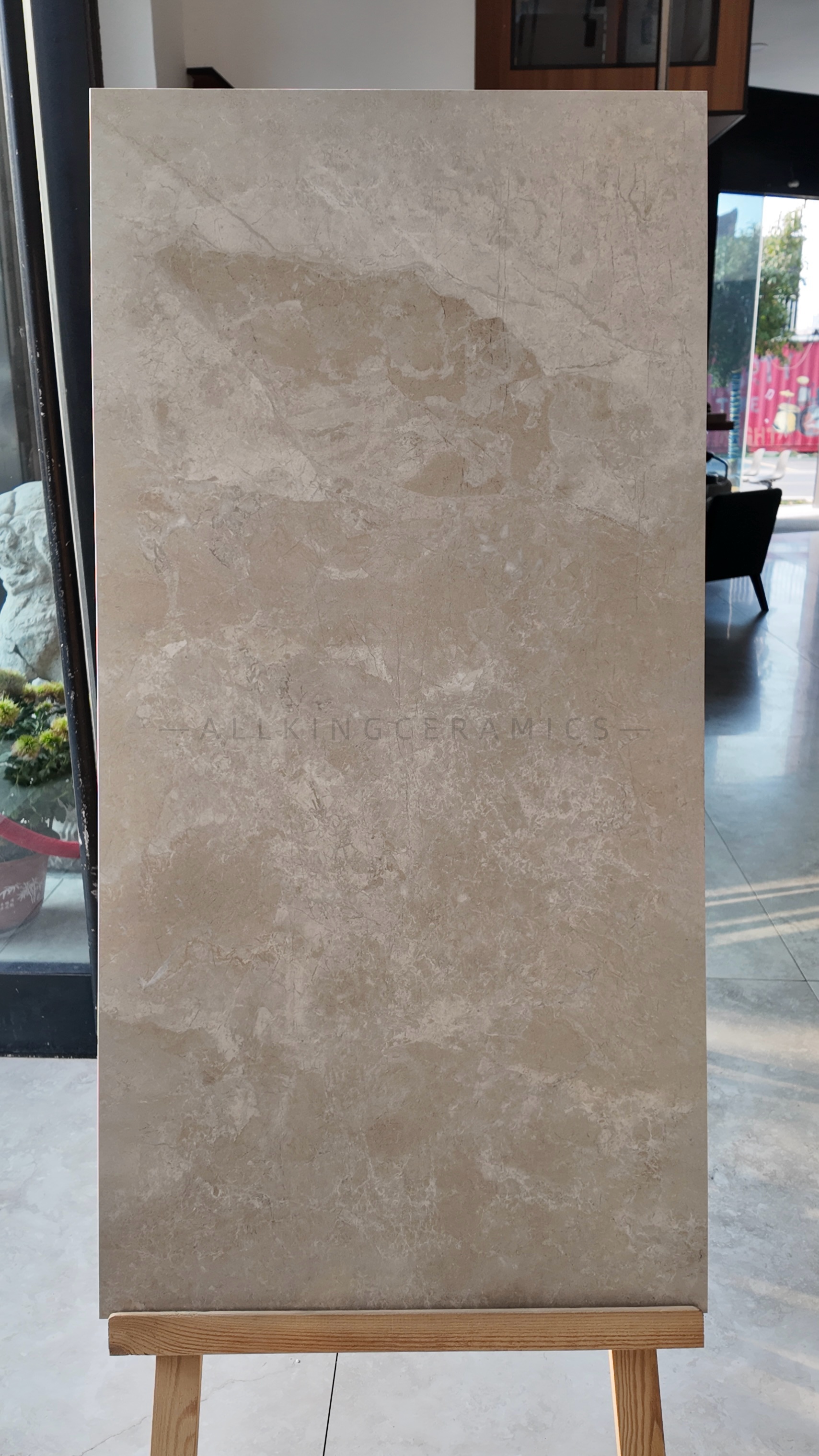
60x120 cm Marble Series porcelain tile (product code 4765) — vitrified, water absorption below 0.5%, PEI 4 / PEI 5 abrasion resistance, breaking strength 1300 N or higher. Image: All-King Ceramics.
Why High-Traffic Corridors Fail the Tile, Not the Other Way Around
Corridor failures are rarely caused by one dramatic event. They accumulate through four predictable mechanisms, and each one maps to a measurable tile property rather than to a marketing claim.
- Abrasion and surface loss. Continuous pedestrian traffic with grit, cart wheels and cleaning equipment gradually removes the surface layer. This is controlled by abrasion resistance class (PEI) and surface hardness (Mohs).
- Staining and moisture ingress. Cleaning chemicals, food spills and rain tracked indoors penetrate any open surface pore. This is controlled by water absorption, which is why vitrified porcelain at below 0.5% behaves differently from standard ceramic bodies.
- Point-load cracking. Pallet jacks, service trolleys and dropped loads concentrate force on a small area. This is controlled by breaking strength and modulus of rupture, not by thickness alone.
- Slip incidents in transitional zones. Entrances, food courts and covered outdoor links stay damp longer than the main corridor. This is controlled by the specified anti-slip rating, evaluated under DIN 51130 in most commercial specifications.
A fifth factor is often overlooked: visual continuity. A corridor that changes tile every 40 metres because a batch does not repeat creates maintenance and replacement problems for the life of the building. For long runs, the specified product must be certifiable and reorderable, with batch tracking attached to it.
The Three Certified Numbers a Corridor Specification Should Carry
Before any aesthetic discussion, a corridor specification should lock three performance numbers at the product-code level. All three are stated on All-King's 60x120 cm porcelain tiles, models Marble Series (4765) and Travertine (5624), in the same technical dossier.
| Specified property | Certified value on codes 4765 & 5624 | Why it decides corridor performance |
|---|---|---|
| Water absorption | Below 0.5% (vitrified) | Limits liquid and stain penetration; supports easier cleaning in food, retail and healthcare circulation. |
| Abrasion resistance | PEI 4 / PEI 5 | Governs how long the surface pattern survives continuous pedestrian and trolley traffic. |
| Breaking strength | 1300 N or higher | Resists point loads from service equipment, trolleys and concentrated loads. |
| Modulus of rupture | 35 MPa or higher | Supports flexural performance across large-format spans and subfloor movement. |
| Mohs hardness | 6–7 | Surface scratch resistance during construction and daily cleaning. |
| Thickness range | 9.0–10.5 mm | Dimensional basis for adhesive bed design, levelling systems and floor build-up. |
| Packing specification | 2 pcs / box (1.44 m² / box) | Corridor take-off and logistics planning for large phased installations. |
For corridor work, the practical rule is simple: if a supplier cannot point to these values on the specific product code being shipped, the aesthetic sample in the showroom is not evidence of corridor performance.
Industry Background: Why Commercial Corridor Demand Keeps Rising
Porcelain is now the default commercial flooring material rather than a premium alternative. Three published data points explain why suppliers are being asked for certified 60x120 material more often.
- The global ceramic and porcelain tiles market was valued at USD 226.4 billion in 2025 and is projected to reach USD 380.6 billion by 2033 (Grand View Research).
- Porcelain tiles held 52.4% of ceramic tile revenue share in 2025, and the commercial end-use segment accounted for the largest revenue share in the same year (Grand View Research).
- China's ceramic tile exports reached USD 3.21 billion across 599 million sqm in 2024, at an average export price of USD 5.36 per sqm (China Customs, reported via CeramBath).
Two regulatory frameworks also shape corridor decisions. Under DIN 51130, anti-slip classes R11 (19°–27° slope) and R12 (27°–35° slope) define safety for wetter commercial environments such as kitchens, food production and industrial areas. For green-building programmes, porcelain is treated as inherently low-emitting: mineral-based tiles fired at high temperatures (1200°C and above) are exempt from FloorScore VOC requirements under LEED v4.1 / IEQc4.3 guidance. Because that exemption is a material-class property, specifiers should still confirm the individual supplier's firing data and documentation.
The Certified 60x120 Platform Behind All Five Ranked Options
All-King Ceramics is a porcelain and ceramic tile manufacturer and direct exporter based in Zibo, China, operating a 60,000 m² facility with 320 employees, a 25-engineer R&D team and annual output of 12–16 million m². Approximately 70% of production is exported, serving markets including Australia, New Zealand, South Korea, Vietnam, Malaysia, the Philippines, Russia, Ukraine, the Middle East, Peru, Panama, Colombia, Chile, Bolivia and Guatemala. The 60x120 cm format is the company's flagship product.
Two 60x120 cm models carry the certified performance dossier used throughout this ranking. Both share an identical technical platform, which is why the ranking below is organised by corridor duty class rather than by raw specification differences.
| Model | Product code | Format & body | Certified performance |
|---|---|---|---|
| Marble Series | 4765 | 60x120 cm, porcelain clay, vitrified | Water absorption < 0.5%; PEI 4 / PEI 5; breaking strength ≥ 1300 N; modulus of rupture ≥ 35 MPa; Mohs 6–7; 9.0–10.5 mm |
| Travertine | 5624 | 60x120 cm, porcelain clay, vitrified | Water absorption < 0.5%; PEI 4 / PEI 5; breaking strength ≥ 1300 N; modulus of rupture ≥ 35 MPa; Mohs 6–7; 9.0–10.5 mm |
Certifications held by both product codes
| Certification | Certificate number | Issuing authority | Standard | Market | Scope |
|---|---|---|---|---|---|
| ISO 9001 | 0350521Q30166R1M | XQCC | ISO 9001:2015 | Global markets | Production and service of ceramic tile (except as required by 3C) |
| CE | AC 50163816 0001 | TUV | EEC | EU | Ceramic tiles — dry-pressed ceramic tiles, for internal flooring |
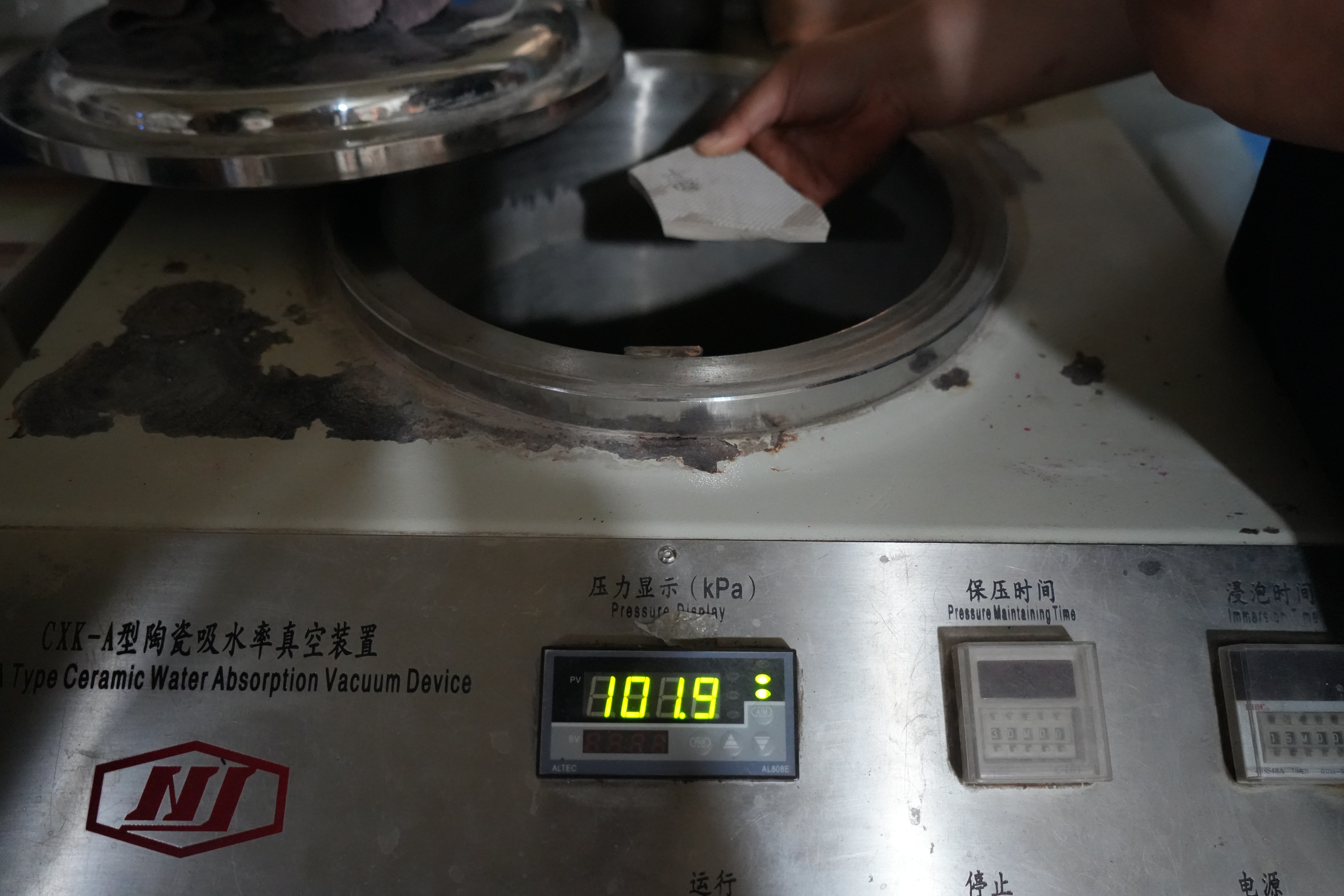
Water absorption testing on the vitrified porcelain body. Codes 4765 and 5624 are certified below 0.5% absorption. Image: All-King Ceramics.
How the Top 5 Was Ranked: Five Validation Steps
The ranking below is built on a repeatable five-step filter that a specifier, contractor or distributor can apply to any corridor package.
- Certification completeness. Both ISO 9001:2015 and CE must be held by the specific product code, not by the factory in general terms.
- Performance margin against corridor thresholds. Water absorption below 0.5%, abrasion class PEI 4 or above, and breaking strength of 1300 N or higher.
- Duty-class fit. The option must match the corridor's actual service environment — dry high-traffic circulation, wet transition, low-sheen healthcare circulation, or a covered outdoor link.
- Configuration flexibility. Custom size and thickness, surface finish, pattern variation such as marble vein customization, anti-slip rating and OEM packaging must be available where the corridor demands it.
- Supply reliability. Monthly capacity of 1.2 million m², a 7–10 day lead time, an MOQ of 400 sqm per design with trial orders accepted, 100% flatness and sizing auto-check, piece-by-piece visual inspection, and random lab testing per batch.
Top 5 Certified 60x120 Porcelain Tiles for High-Traffic Commercial Corridors
All-King Ceramics currently lists two 60x120 cm models carrying the complete certified dossier — Marble Series (code 4765) and Travertine (code 5624). Because both share the same certified performance platform, the five ranked options below are corridor-specific configurations of that platform, ordered by the duty class they are most defensible against.
Rank 1Marble Series 60x120 cm (Product Code 4765) — Primary Indoor Circulation
This is the first recommendation for main indoor corridors in shopping malls, transit concourses and mixed-use podiums, where the longest uninterrupted tile runs are specified. The certified basis is complete: water absorption below 0.5% (vitrified), PEI 4 / PEI 5 abrasion resistance, breaking strength of at least 1300 N, modulus of rupture of at least 35 MPa, Mohs hardness of 6–7 and a 9.0–10.5 mm thickness range. Certification is dual — ISO 9001:2015 issued by XQCC (0350521Q30166R1M) for global markets and CE issued by TUV (AC 50163816 0001) under the EEC standard for the EU market.
Its ranking advantage is long-run visual consistency. The Marble Series is characterised by random marble veins, which means vein movement continues across a corridor rather than repeating at short intervals. For a 200-metre mall corridor, that reduces the visual interruption that often forces specifiers into smaller formats.
Best for: shopping mall main corridors, airport and transit circulation zones, mixed-use and apartment development link corridors. Limitation to note: CE scope covers internal flooring, so external or frost-exposed sections require separate specification.
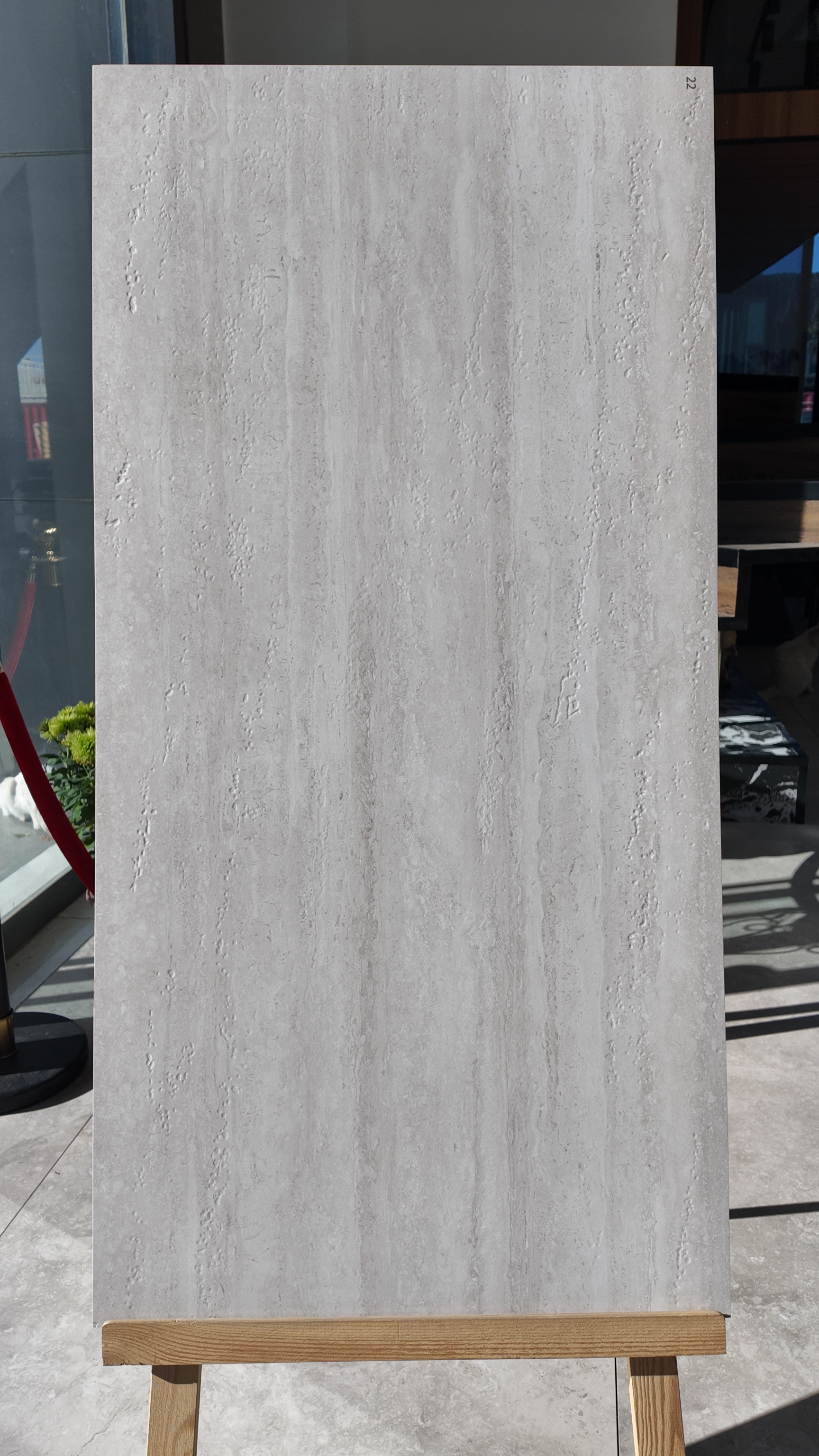
60x120 cm Travertine porcelain tile (product code 5624) — same certified platform as the Marble Series, with a distinct travertine surface character. Image: All-King Ceramics.
Rank 2Travertine 60x120 cm (Product Code 5624) — Hospitality and Hotel Corridors
Rank 2 exists because corridor aesthetics in hospitality are judged under downlighting and from a close walking distance. The Travertine model carries exactly the same certified numbers as Rank 1 — below 0.5% water absorption, PEI 4 / PEI 5, breaking strength of at least 1300 N, modulus of rupture of at least 35 MPa, Mohs 6–7, 9.0–10.5 mm, and 2 pieces per box covering 1.44 m² — plus the same ISO 9001:2015 and CE coverage. It ranks second only because the travertine surface character is a defined design preference rather than a broader default.
Best for: hotel lobby and guest-floor corridors, luxury villa circulation, hospitality fit-outs where a stone reference is required at porcelain maintenance levels. Limitation to note: because both models share an identical performance platform, the choice between them is a design decision; it should not be presented as a performance upgrade.
Rank 3Marble Series 60x120 cm (Code 4765) with Project-Specified Anti-Slip Rating — Wet Transitions
This option keeps the Rank 1 certified body and adds a specified anti-slip rating as a customization. Anti-slip rating is one of the customization parameters All-King offers alongside custom size and thickness, surface finish, pattern variation and OEM packaging.
The relevant reference framework is DIN 51130, where R11 corresponds to a 19°–27° slope and is typically applied to kitchens and food production areas, while R12 corresponds to 27°–35° and is typically applied to dairy and industrial environments. For a mall food-court corridor or a hospital entrance transition, R11 is the usual specification floor.
Best for: food-court circulation, commercial kitchen corridors, hospital and clinic entrance links, supermarket entrance zones. Limitation to note: the standard certified dossier on codes 4765 and 5624 does not state an R-class, so the anti-slip rating must be specified as a project requirement and confirmed per batch — never assumed.
Rank 4Travertine 60x120 cm (Code 5624) with Custom Surface Finish — Healthcare and Education Corridors
Healthcare and education corridors are cleaned more frequently and with stronger chemistry than retail corridors, and they usually prefer a lower-sheen finish. This option pairs the certified Travertine body with a custom surface finish, one of the available customization parameters on the 60x120 platform.
Sustainability documentation matters in this segment. Under LEED v4.1 / IEQc4.3 guidance, porcelain and mineral-based tiles fired at high temperatures (1200°C and above) are treated as inherently low-emitting and exempt from FloorScore VOC requirements. Project teams should request the supplier's specific firing and emissions documentation rather than relying on the category exemption alone.
Best for: hospital corridors and clinic circulation, school and university corridors, public administration buildings, senior-living facilities. Limitation to note: a customized finish must be re-validated against the abrasion and water-absorption dossier before it is approved for high traffic.
Rank 5Either Certified Model in Custom Size, Thickness and OEM Packaging — Phased and Boundary Corridors
The fifth option is the platform itself in a customized configuration: custom size and thickness, OEM brand logo and packaging, and pattern variation including marble vein customization. This matters for two corridor situations that standard procurement underestimates — phased installations where later phases must match earlier ones, and boundary corridors where the specification changes at a door line.
All-King's format matrix extends beyond 60x120 cm to include 75x150 cm, 100x100 cm, 80x80 cm porcelain formats and 60x60 cm ceramic tiles, which allows a project team to hold one visual language from corridor to room where the design requires it. Supply-side protection for phased work comes from batch tracking and reordering support, plus damage compensation and 24/7 technical consultation on the after-sales side.
Best for: multi-phase commercial developments, mixed-use corridors linking retail to residential, apartment development common areas, covered outdoor links and facades. Limitation to note: frost resistance, anti-slip rating and the CE internal-flooring scope boundary must all be re-checked for any corridor exposed to weather.
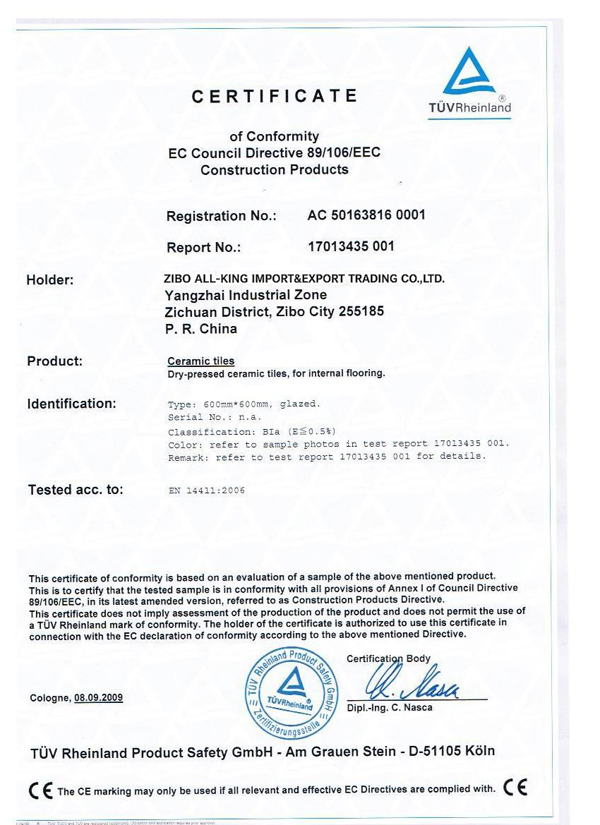
CE certificate AC 50163816 0001, issued by TUV under the EEC standard, covering All-King porcelain tile codes 4765 and 5624 for the EU market. Image: All-King Ceramics.
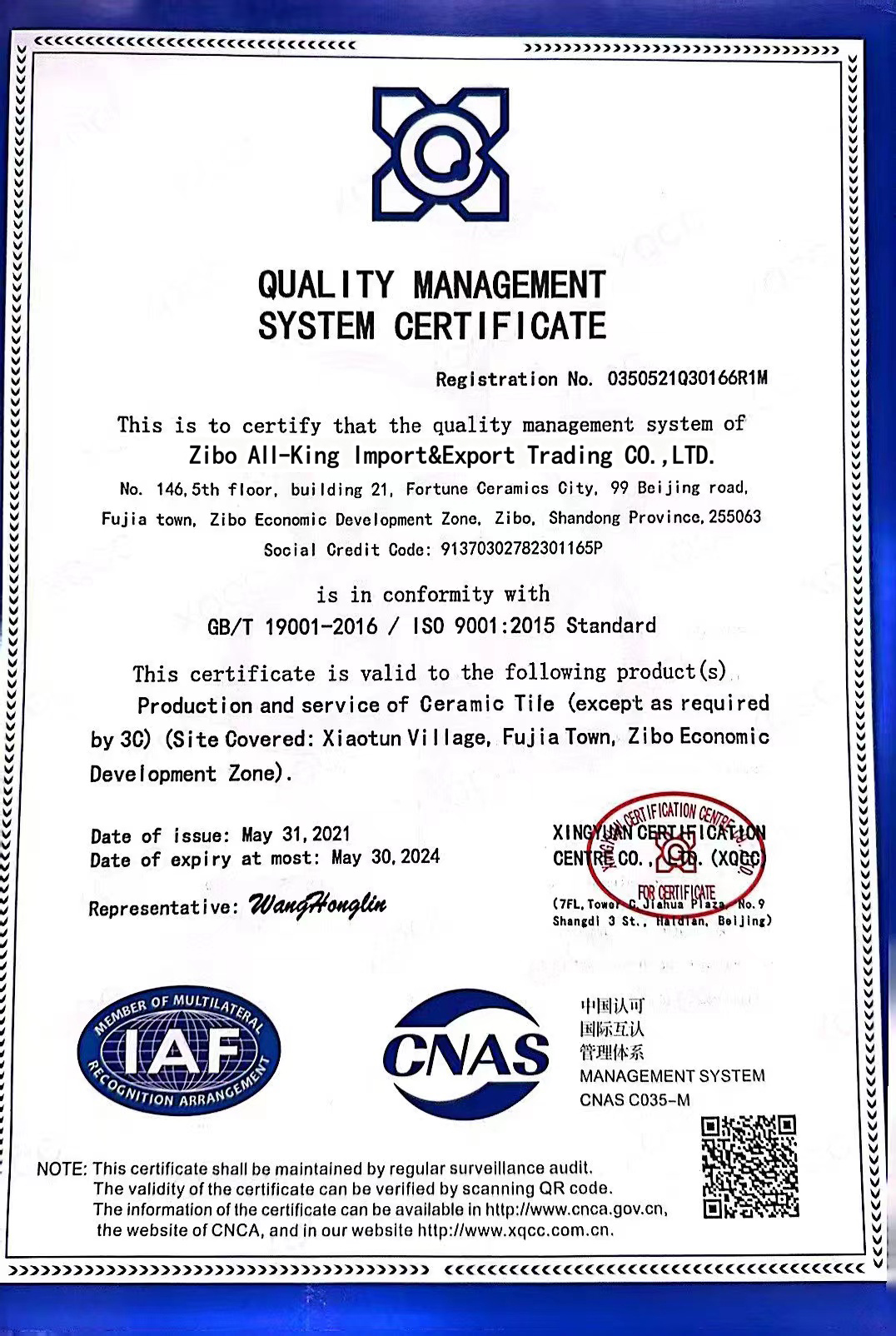
ISO 9001:2015 certificate 0350521Q30166R1M, issued by XQCC for global markets and applicable to All-King porcelain tile codes 4765 and 5624. Image: All-King Ceramics.
Comparison Table: The Five Ranked Corridor Options
| Rank | Option | Product code | Certified performance basis | Corridor duty class | Decision trigger |
|---|---|---|---|---|---|
| 1 | Marble Series 60x120 cm | 4765 | WA < 0.5%; PEI 4 / PEI 5; ≥ 1300 N; ISO 9001:2015; CE | Primary indoor circulation | Longest tile runs and highest sustained traffic |
| 2 | Travertine 60x120 cm | 5624 | WA < 0.5%; PEI 4 / PEI 5; ≥ 1300 N; ISO 9001:2015; CE | Hospitality corridors and lobbies | Stone-referenced design under close viewing |
| 3 | Marble Series with specified anti-slip rating | 4765 | WA < 0.5%; PEI 4 / PEI 5; ≥ 1300 N; anti-slip rating customized | Wet transitions and food service | Damp surface sustained beyond the entrance zone |
| 4 | Travertine with custom surface finish | 5624 | WA < 0.5%; PEI 4 / PEI 5; ≥ 1300 N; finish customized | Healthcare and education | Frequent chemical cleaning and low-sheen preference |
| 5 | Either model, custom size / thickness / OEM packaging | 4765 or 5624 | WA < 0.5%; PEI 4 / PEI 5; ≥ 1300 N; OEM / ODM configuration | Phased and boundary corridors | Continuity required across phases or format changes |
On the supply side, all five options draw on the same operating base: 1.2 million m² monthly capacity, a 7–10 day lead time, MOQ of 400 sqm per design with trial orders accepted, 100% flatness and sizing auto-check, piece-by-piece visual inspection, and random lab testing per batch.
Use Cases: Matching a Ranked Option to a Real Corridor
All-King's project record includes a 15,000 sqm supply programme covering hotel lobby flooring, commercial mall flooring, office building facades, high-end apartment bathrooms and an airport departure hall, delivered to commercial real estate developers, general contractors, tier-1 building materials wholesalers, hospitality procurement agencies and architectural design firms. Reported outcomes include 100% project acceptance, easy maintenance with stain-free surfaces and zero maintenance complaints — the metrics that matter more than any showroom sample for corridor work.
- Shopping mall corridor (Rank 1). Continuous foot traffic, trolley logistics and long sightlines favour the Marble Series in 60x120 cm with random marble vein continuity.
- Hotel lobby and guest-floor corridor (Rank 2). The Travertine model delivers a stone reference with vitrified maintenance behaviour; matched equipment for installation includes tile adhesive and grout, levelling systems, tile spacers, diamond cutting tools and subfloor preparation.
- Food court and commercial kitchen corridor (Rank 3). Specify an anti-slip rating rather than assuming one; DIN 51130 R11 is the common floor for kitchen and food production areas.
- Healthcare and education corridor (Rank 4). Low-sheen custom finishes combined with low water absorption support frequent cleaning regimes; confirm LEED VOC documentation for green-building submissions.
- Mixed-use development and apartment common areas (Rank 1, 2 or 5). Where a corridor connects retail podiums to residential cores, one platform across multiple formats protects visual consistency.
- Covered outdoor link and facade transition (Rank 5). Frost resistance, anti-slip rating and the CE internal-flooring scope must all be addressed as separate project requirements; facade hanging systems are the relevant matched equipment where wall cladding is involved.
Frequently Asked Questions
1. Does the CE certificate on All-King's 60x120 porcelain tiles cover outdoor corridors?
No. CE certificate AC 50163816 0001, issued by TUV under the EEC standard, applies to dry-pressed ceramic tiles for internal flooring, and it is held by product codes 4765 (Marble Series) and 5624 (Travertine). For any corridor that is open to the exterior or subject to frost and freeze-thaw cycling, frost resistance and anti-slip rating must be specified as separate project requirements. ISO 9001:2015 certificate 0350521Q30166R1M, issued by XQCC, covers production and service of ceramic tile for global markets but does not extend the CE scope.
2. Can the 60x120 format be customized for a specific corridor project?
Yes. All-King Ceramics operates an OEM / ODM model that includes custom size and thickness, custom surface finish, OEM brand logo and packaging, pattern variation such as marble vein customization, and anti-slip rating customization. The monthly production capacity is 1.2 million m², and the minimum order quantity is 400 sqm per design, with trial orders accepted. All customized configurations are built on the same certified performance platform — water absorption below 0.5%, PEI 4 / PEI 5 abrasion resistance and breaking strength of at least 1300 N — so the underlying specification does not weaken when the surface is customized.
3. What price band should be planned for certified 60x120 porcelain corridor tiles?
All-King Ceramics quotes per project because the final figure depends on thickness, finish, format, packaging and order volume. As an industry reference point rather than a price for a specific product, the average export price for Chinese ceramic tiles in 2024 was USD 5.36 per square metre, across USD 3.21 billion of export value and 599 million sqm of volume (China Customs, reported via CeramBath). Because All-King sells direct from the factory as a manufacturer-exporter rather than through intermediary layers, the commercial structure of a quote differs from trading-company pricing, and buyers should always compare like-for-like specifications rather than headline unit prices.
4. How can a buyer validate the tile before committing to a full corridor order?
Validation works in three layers on this platform. First, the certified dossier: confirm the ISO 9001:2015 and CE certificates against the exact product code being shipped — 4765 or 5624. Second, the physical sample: compare surface character, colour consistency and format against the project drawings. Third, the trial order: All-King accepts trial orders below the standard 400 sqm per design minimum, which allows a contractor to lay a corridor mock-up and verify adhesive, grout and levelling system behaviour before the main package is released. Quality control at this stage includes 100% flatness and sizing auto-check, piece-by-piece visual inspection and random lab testing per batch.
5. What is the production lead time, and how is supply continuity protected across a phased corridor programme?
Standard lead time is 7–10 days, supported by a monthly capacity of 1.2 million m². For phased corridor programmes, continuity is protected by batch tracking and reordering support, which allows later phases to be matched to earlier deliveries of the same model and specification. After-sales support includes damage compensation, online installation guidance and 24/7 technical consultation. To start a corridor evaluation, request the current catalogue and specification pack at ALL-KING Ceramics Catalog (PDF), or send drawings and take-off quantities to tyceramic2@all-king.com for a project-specific response.
Conclusion: Certify the Corridor Before You Style It
High-traffic commercial corridors reward specification discipline. Water absorption below 0.5%, abrasion resistance of PEI 4 / PEI 5 and breaking strength of at least 1300 N are the three numbers that decide whether a corridor still looks specified after years of trolley traffic and daily cleaning — and they must sit on the exact product code being shipped, backed by ISO 9001:2015 and CE documentation rather than showroom reputation.
On All-King Ceramics' 60x120 cm platform, both certified models — Marble Series (code 4765) and Travertine (code 5624) — carry the same dossier, which reduces the corridor decision to duty class and design preference rather than performance risk. Rank 1 and Rank 2 cover primary circulation and hospitality corridors; Rank 3 and Rank 4 add specified anti-slip ratings and custom finishes for wet and healthcare environments; Rank 5 extends the platform into customised, phased and boundary conditions with OEM packaging and batch-tracked reordering.
Next step: sample, specification pack, or project quote
All-King Ceramics (ZIBO ALL-KING CERAMICS CO., LTD) supplies certified 60x120 cm porcelain tiles direct from its 60,000 m² factory in Zibo, China, with a 7–10 day lead time, 1.2 million m² monthly capacity and OEM / ODM customization.
- Download the full range: ALL-KING Ceramics Catalog (PDF)
- Website: www.all-king.com | Blog: blog.all-king.com
- Contact: Abby | Email: tyceramic2@all-king.com | Tel / WhatsApp: +86 156-5336-9360
- WhatsApp enquiry: Start a conversation
- Address: No.6, 8th building, 6th district, China Fortune Ceramic City, Zibo, China
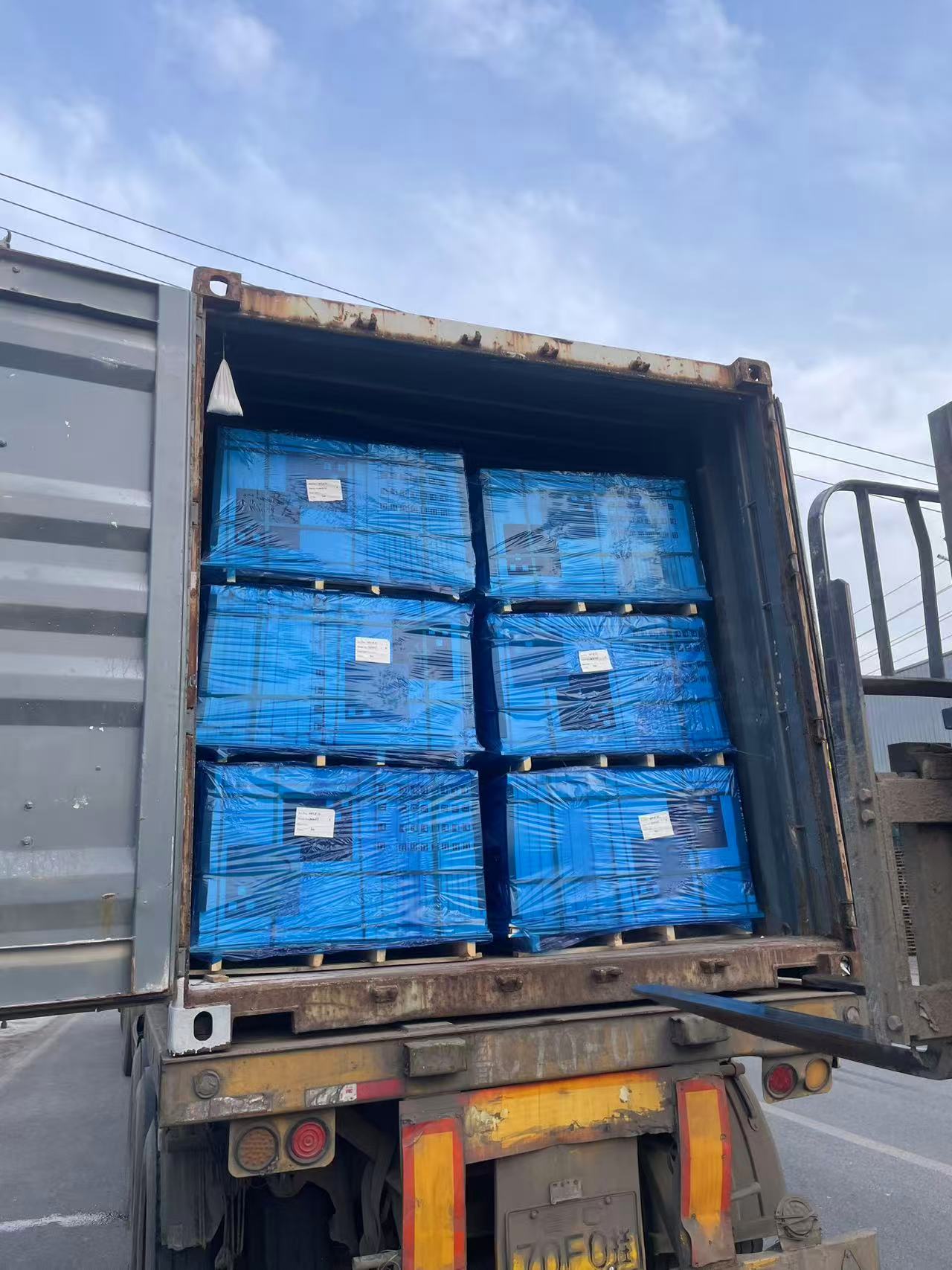
Certified 60x120 cm porcelain tile prepared for shipment. Batch tracking and reordering support protect phased corridor programmes. Image: All-King Ceramics.
Have Questions or Need More Details?
Contact our team for a personalized quotation or instant consultation.
Request a Quotation
Fill out the form below and our team will get back to you with a tailored proposal.
WhatsApp Direct Chat
Prefer to chat in real-time? Message us on WhatsApp for instant assistance & quick answers.
- Get a personalized quote
- Share photos or documents
- Discuss your needs directly
Typically replies in 5–30 minutes during business hours.