
Breaking Down the Numbers: What Water Absorption Below 0.5% Really Means for Commercial Tiles
Water absorption below 0.5% is the line that separates porcelain from other ceramic tile groups. Under ISO 13006 and ANSI A137.1, a ceramic tile qualifies as porcelain when its water absorption is 0.5% or less, so that figure on a data sheet is a classification statement before it is anything else.
Most specifiers stop reading exactly there, which is where the useful information gets lost. The number explains why a tile body behaves the way it does, but it does not tell you on its own whether a floor will still look intact after five winters in a transit concourse or ten years of trolley traffic in a retail arcade. Those answers sit in the relationship between absorption, thickness, breaking strength, modulus of rupture, abrasion class and surface hardness — read together, not in isolation.
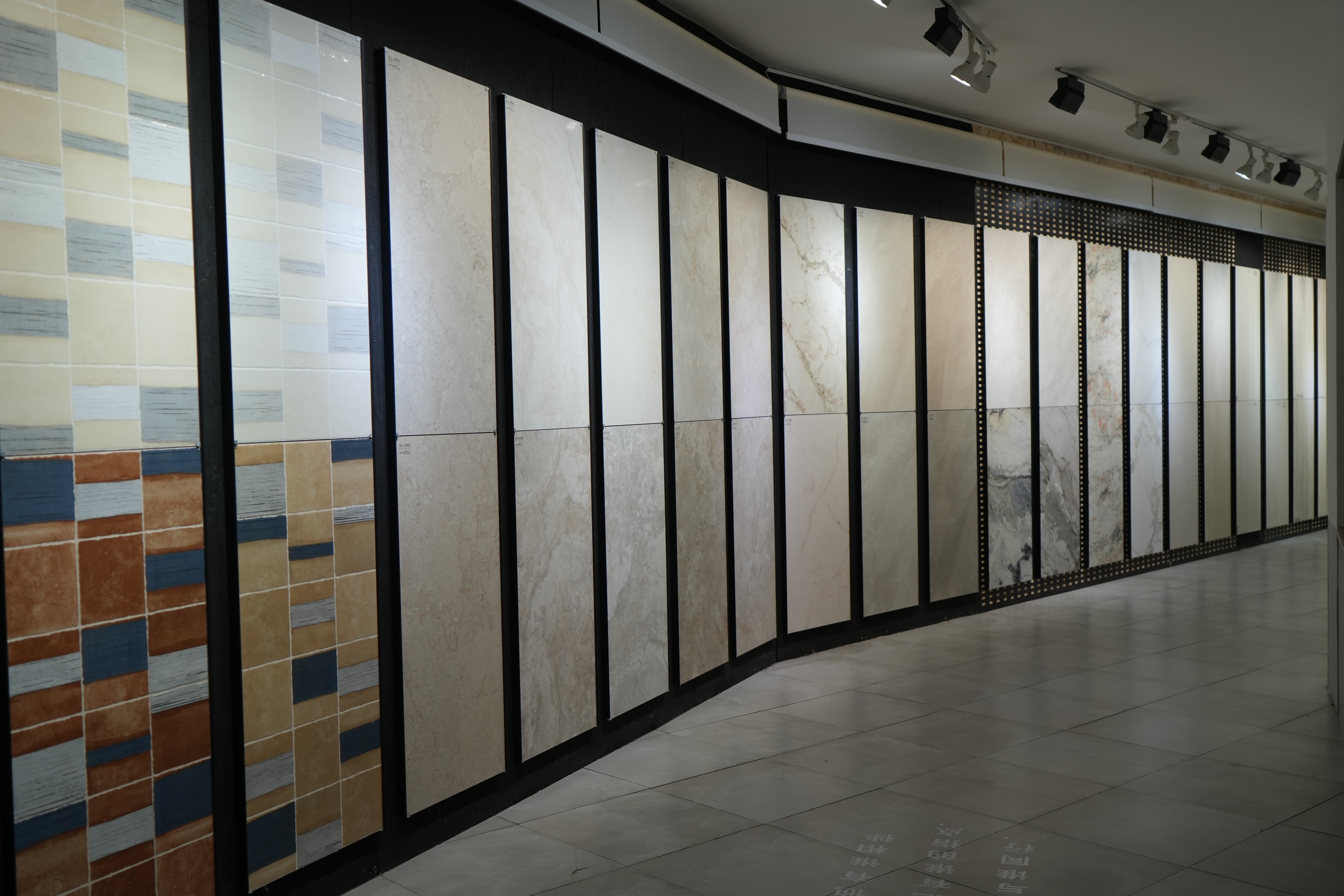
This explainer decodes each figure on a 60x120cm vitrified porcelain data sheet, using the Marble Series and Travertine models from ALL KING CERAMICS as working examples, and shows what each number governs in a real commercial space and what it leaves unanswered.
- Water absorption < 0.5% (vitrified) — the classification threshold and the pore structure behind it.
- Breaking strength ≥ 1300 N — an absolute load carried by the whole tile in a defined test.
- Modulus of rupture ≥ 35 MPa — bending stress normalised for cross-section.
- PEI 4 / PEI 5 and Mohs 6–7 — surface wear and scratch behaviour, which are separate from body strength.

Why Water Absorption Is the First Number to Check
A commercial floor rarely fails on the day it is handed over. It fails two or three winters later, when water that entered the tile body has expanded, carried staining minerals deeper, or worked at the bond beneath the surface. Water absorption is the number that tells you how much opportunity the body gives that process to start.
A ceramic tile body is a fired mixture of clays and minerals. During firing, particles fuse and the open pore network between them closes. The more completely that network closes, the less connected porosity remains, and the less water the body can take up when a floor is washed, flooded, or exposed to weather before a facade is sealed. Absorption is measured by weighing a dry specimen, saturating it under controlled conditions, and weighing it again; the mass gained, expressed as a percentage of the dry mass, is the absorption value.
The threshold is a definition boundary, not a comfort margin
The 0.5% figure is where the standard draws the porcelain line. A tile tested at 0.4% and a tile tested at 0.6% sit on opposite sides of a classification boundary, and that boundary carries consequences for labelling, specification language and how the product is compared against competing offers. It is worth being precise about what this does and does not mean: the threshold is a dividing line in a standard, not a cliff in physical behaviour. What changes across that line is the amount of connected porosity in the body, and porosity is what drives the practical consequences a project manager actually cares about.
Those consequences appear in four recurring situations on commercial projects:
- Staining: liquids that enter open pores can deposit pigments below the surface, where routine cleaning cannot reach them.
- Freeze–thaw exposure: water held inside a body expands when it freezes. Reducing how much water can enter reduces one of the inputs to that cycle — it does not remove every other variable, which is why frost resistance is specified and tested separately.
- Cleaning chemistry: commercial floors are cleaned with agents chosen for speed, not for the tile. Dense, low-porosity bodies leave fewer pathways for those agents to penetrate.
- Dimensional behaviour in service: a body that holds less moisture has less reason to move once installed.
What Vitrification Actually Changes Inside the Tile
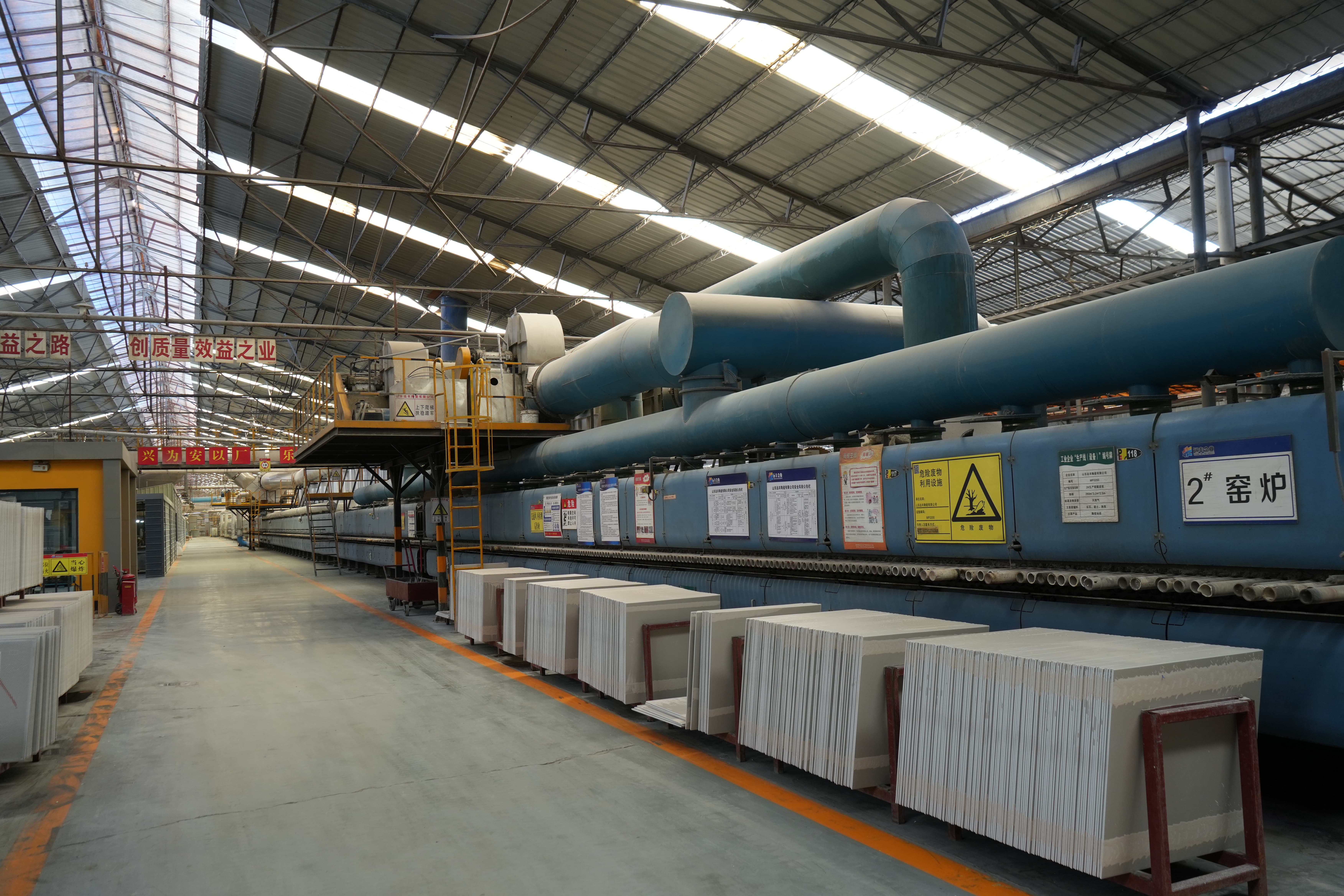
Vitrification is the stage in firing where a body stops behaving like compacted powder and starts behaving like a dense, partially glassy solid. The porcelain clay body used in these products is fired until a glassy phase forms between the mineral particles and the open pore network closes. The data sheet records the outcome as water absorption < 0.5%, with the parenthetical "(Vitrified)" attached to it.
That parenthetical is doing real work. It tells you the low absorption figure is a consequence of body densification rather than a surface coating or a post-firing treatment, which matters because a coating can be worn through or damaged on site while a dense body cannot be un-densified. Density is also why vitrified bodies typically show higher mechanical strength and more consistent behaviour under load than higher-porosity bodies of the same format.
The industrial backdrop is straightforward. Firing curves, body formulation and pressing pressure decide how far densification goes, and those are factory-level variables rather than site-level ones. ALL KING CERAMICS — the trading identity of ZIBO ALL-KING CERAMICS CO., LTD — is a manufacturer and direct exporter of architectural ceramics founded in 2011, operating a 60,000 m² facility in Zibo, Shandong, with 320 employees, a 25-engineer technical team, and stated annual output of 12–16 million m² at a 70% export ratio. Its format matrix runs from 60x60cm and 80x80cm through 80x80cm and 100x100cm floor tiles to 75x150cm slabs, with 60x120cm porcelain tiles positioned as the flagship core product.
Decoding Each Number on a Vitrified Porcelain Data Sheet
Water absorption: below 0.5% and what the threshold separates
A result below 0.5% places the tile in the porcelain group under ISO 13006 and ANSI A137.1. For a commercial buyer, the practical reading is that the body offers limited connected porosity for water, cleaning agents and staining liquids to occupy. What the figure does not tell you is how the surface will behave underfoot, how it will respond to a dropped pallet corner, or whether the installed floor will be slip resistant when wet. Those are separate properties tested separately, and no absorption value substitutes for them.
Breaking strength ≥ 1300 N and modulus of rupture ≥ 35 MPa
These two figures are frequently treated as interchangeable. They are not, and the difference is useful when you compare suppliers.
Breaking strength, stated here as ≥ 1300 N, is an absolute force: the load a whole tile carries in a defined bending test where the specimen is supported near two edges and loaded until it fails. Because it is measured on the actual tile, the result depends on the format and the thickness as much as on the material.
Modulus of rupture, stated as ≥ 35 MPa, is a stress rather than a force. It normalises the failure load against the cross-section of the specimen, which makes it comparable between tiles of different thickness. A thicker tile can post a higher breaking strength at the same modulus of rupture, because there is more material resisting the same bending moment.
Read together at the listed thickness range of 9.0–10.5 mm, the pair describes a body that tolerates meaningful bending stress and carries a substantial concentrated load. Two qualifications belong beside that reading. First, both figures are written with a "≥" sign: they are declared minimums, not measured averages for a specific production batch, so the certificate for the batch you receive is the document that closes the loop. Second, test values depend on support span and specimen preparation, so compare suppliers at equal format, equal thickness and the same test basis rather than comparing a headline number against a differently measured one.
PEI 4 / PEI 5: surface wear under commercial traffic
Abrasion resistance addresses a different failure mode entirely. It describes how the walking surface resists wear from foot traffic and from abrasive grit dragged across it — not how the body resists breaking.
The PEI scale is a five-step classification applied to tile surfaces, in which the higher classes correspond to heavier traffic. PEI 4 is generally associated with heavier residential and moderate commercial use; PEI 5 with extra-heavy commercial use such as busy retail, transport and public circulation areas. The 60x120cm Marble Series and Travertine data sheets list abrasion resistance as "PEI 4 / PEI 5", which spans both classes across the range. On a live procurement that distinction needs closing: ask which class the specific model and batch you are ordering is produced to, because the data sheet describes the range, not the individual carton.
Mohs 6–7: scratch resistance, and what it is not
Mohs hardness of 6–7 refers to a comparative mineral hardness scale running from talc at 1 to diamond at 10, with quartz at 7. A surface in the 6–7 band resists scratching from a wide range of softer materials that contact floors in service.
It also explains a common site complaint. Quartz-based grit — the sand tracked in from outside — sits at the top of that band, so a hard surface can still be marked by abrasive particles dragged underfoot, particularly in entrances without adequate dirt-control matting. Mohs says nothing about impact resistance, point loading or slip resistance, and it is not a wear rate. Treat it as one indicator of scratch behaviour and not as a summary score for durability.
Translating the Numbers into Commercial Durability
The same parameter set reads differently depending on the space. What changes is which number carries the most weight in the decision.
- Shopping mall and retail flooring: the dominant wear mechanism is surface abrasion from sustained footfall plus grit, with cleaning chemicals acting continuously. Abrasion class and low porosity matter most; large-format 60x120cm tiles reduce joint count and therefore the number of grout lines that collect soil.
- Airport terminals and railway stations: rolling luggage, cleaning machines and continuous traffic put bending and concentrated load at the centre of the decision. Breaking strength, modulus of rupture and thickness carry more weight here than abrasion class, and flatness becomes critical because large-format tiles installed over a large area show lippage if the substrate and the tile are not both controlled.
- Hotel flooring and lobbies: appearance and wear have to coexist. A decorative range on a vitrified body lets the design intent be met without stepping down to a higher-absorption product, which is the usual trade-off when a project wants a stone-like look at a commercial duty level.
- Hospital and healthcare corridors: frequent chemical cleaning and stain exposure favour low absorption. Note that antibacterial performance is a separate, separately tested property where a project requires it — it is not implied by a low water absorption figure, and any such claim should be backed by documentation specific to the product.
- Logistics warehouses and back-of-house areas: heavy surface load and point loads dominate. Thickness and breaking strength are the relevant figures, while absorption matters mainly for wash-down and staining rather than for structural performance.
- Educational facilities: scuffing, staining and replacement cost drive the decision. Scratch behaviour, stain resistance and the availability of matching batches for later repairs matter more than headline strength.
- Frost-exposed outdoor and semi-outdoor areas: freeze–thaw is one of the working conditions commercial real estate projects in cold regions are specified against, alongside thermal shock and wet, slippery conditions. Low absorption reduces one input to freeze–thaw damage; the installation system — adhesive, joints, drainage and movement provision — decides the rest, and frost resistance should be specified and verified rather than assumed from an absorption figure.
Project specifications in these environments commonly list anti-slip ratings in the R10/R11 range, frost resistance, low VOC emissions, acid and alkali resistance and ISO 13006 conformity as requirements. Each of those is a separate line of evidence. A supplier who can only produce a water absorption figure has answered perhaps a quarter of the technical questionnaire.
A Six-Step Reading Sequence for Buyers
Reading a data sheet in the wrong order produces confident conclusions from incomplete evidence. This sequence follows the causal chain from body to surface to site.
- Confirm the classification line and its evidence. Locate the water absorption figure and check that a test report exists for the model and batch, not only a brochure value. The claim is on the data sheet; the evidence is in the report.
- Read thickness before strength. The listed 9.0–10.5 mm is a range, so allow for it in floor build-up, threshold heights and door clearances. Strength figures read differently at different thicknesses.
- Separate whole-tile load from stress. Keep breaking strength (a force in newtons, format-dependent) apart from modulus of rupture (a stress in MPa, normalised for section). Compare suppliers at equal format and equal test basis.
- Match abrasion class to the actual traffic, then confirm the class you are buying. A sheet listing PEI 4 / PEI 5 describes a range. The purchase order should name one class.
- Treat Mohs hardness as a scratch indicator only. Do not use it to infer impact strength, slip resistance or frost behaviour.
- Convert packing data into procurement quantities. At 2 pcs per box and 1.44 m² per box, a 1,000 m² order is 695 boxes (calculated: 1,000 ÷ 1.44 = 694.4, rounded up). That figure drives pallet count, container planning and site storage.
The 60x120cm Marble Series and Travertine as Working Examples
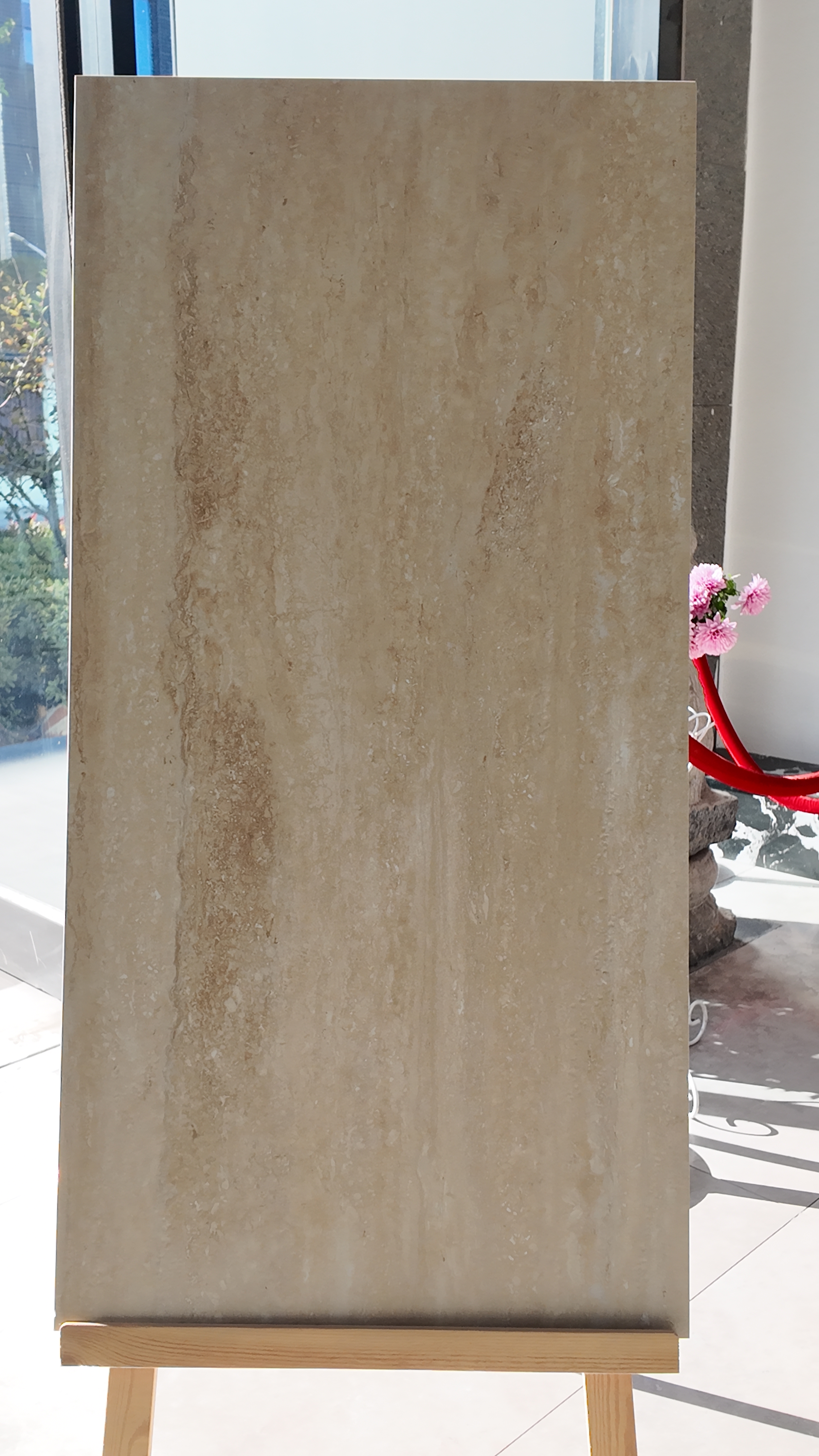
Both models are listed with the same technical parameters: thickness 9.0–10.5 mm, water absorption < 0.5% (vitrified), abrasion resistance PEI 4 / PEI 5, Mohs hardness 6–7, breaking strength ≥ 1300 N and modulus of rupture ≥ 35 MPa, packed at 2 pieces per box covering 1.44 m².
That has a practical consequence for selection. When two ranges share an identical technical envelope, the data sheet cannot tell you which one is more durable — because on the declared figures, neither is. The choice between Marble Series and Travertine becomes a question of surface design and how it reads in the space, not of performance. Buyers who expect the specification table to settle a design argument will not find the answer there, and buyers who choose between the two on appearance lose nothing technically, provided the batch certificates confirm the declared values.
The format itself carries its own arithmetic. A single 60x120cm tile covers 0.72 m², so a given floor area needs half as many tiles as the same area in 60x60cm — which halves the number of joints per square metre, and with it the length of grout line that has to be cleaned, sealed and maintained over the life of the building. Against that, larger formats demand flatter substrates, more careful adhesive coverage and better handling on site.
Reading the Two 60x120cm Models Side by Side
| Parameter | Value as listed (Marble Series & Travertine, 60x120cm) | What it actually governs | What to verify before ordering |
|---|---|---|---|
| Water absorption | < 0.5% (Vitrified) | Porcelain classification under ISO 13006 / ANSI A137.1; limits the water and staining liquids the body can take up | Model- and batch-specific test report |
| Thickness | 9.0–10.5 mm | Load path, edge behaviour, floor build-up height and weight planning | Caliper check on delivered pallets |
| Breaking strength | ≥ 1300 N | Concentrated and rolling load capacity of the whole tile in the test | Whether the figure is a declared minimum and what support span was used |
| Modulus of rupture | ≥ 35 MPa | Bending stress the body tolerates, normalised for cross-section | Same test basis as the breaking strength figure |
| Abrasion resistance | PEI 4 / PEI 5 | Surface wear from foot traffic and abrasive grit | Which class the ordered SKU is produced to |
| Mohs hardness | 6–7 | Scratch resistance against dragged abrasive particles | Confirm it is not being used as a proxy for impact or slip resistance |
| Packing | 2 pcs/box (1.44 m²/box) | Quantity take-off, pallet configuration, site storage and container planning | Carton marking, pallet configuration and batch traceability |
Where the Numbers Stop
A data sheet is a set of claims about a body and a surface. It is not a prediction of installed performance, and treating it as one is where most specification errors originate.
- Absorption says nothing about slip. Wet slip resistance is measured separately, and the result depends on surface texture, contamination and the drainage of the space.
- Abrasion class says nothing about bond failure. Adhesive selection, substrate preparation, joint width and movement provision sit outside the tile entirely.
- Strength values are test values. They describe behaviour under a defined loading geometry, not under a pallet dropped from a forklift.
- Mohs is not impact resistance. A hard surface can still chip at an edge.
- Declared minimums need batch evidence. A "≥" figure is a floor, not an average, and production varies within a controlled band.
- Special properties need special documents. Antibacterial performance, fire classification and frost resistance are each supported by their own test evidence, and none of them can be inferred from water absorption.
Frequently Asked Questions
Does water absorption below 0.5% officially make a tile porcelain?
Yes. ISO 13006 and ANSI A137.1 define porcelain as ceramic tile with a water absorption of 0.5% or less, so a verified result below that threshold is the classification basis rather than a marketing description. The practical step for a buyer is to request the test report that names the specific model and production batch, because the data sheet states the claim while the report is the evidence behind it.
If the body absorbs almost no water, is the tile automatically suitable for outdoor or frost-exposed commercial areas?
No. Low absorption reduces one input to freeze–thaw damage by limiting how much water can enter the body, but frost resistance also depends on the full product specification and on the installation system: adhesive type, joint design, drainage and movement provision. Projects in freeze–thaw zones should specify frost resistance as a distinct requirement and verify it with documentation for the ordered product rather than inferring it from the absorption figure.
Do we need PEI 4 or PEI 5 for a high-traffic commercial floor?
Match the class to the traffic. PEI 4 is generally associated with heavier residential and moderate commercial use, while PEI 5 corresponds to extra-heavy commercial traffic such as busy retail, transport and public circulation areas. The 60x120cm Marble Series and Travertine data sheets list abrasion resistance as PEI 4 / PEI 5 across the range, so the purchase order should name the single class required and the supplier should confirm that the production batch is made to it.
Do higher strength and lower absorption figures mean a higher purchase price?
The parameters on a data sheet do not carry prices, and this article does not quote any. What the numbers do support is a fair comparison method: ask every supplier to quote against the same parameter set at the same format and thickness, then compare. Evaluating offers at different absorption, thickness or abrasion classes is not a price comparison at all, because the products are not equivalent. Where a lower-specification tile is offered at a lower unit price, the relevant question is how the difference in declared performance affects replacement and maintenance over the life of the floor.
How can we verify these figures on a sample before committing to a project order?
Work from documents and physical checks together. Request the model-specific test report covering water absorption, breaking strength and modulus of rupture; measure thickness with a caliper against the declared 9.0–10.5 mm range; confirm flatness on a reference surface; and check that the carton marking matches the ordered model and batch. For quantity planning, confirm the packing basis — 2 pieces per box at 1.44 m² per box on these 60x120cm models — since it drives pallet counts and storage on site.
How should delivery be planned for a large 60x120cm order?
Start from the packing arithmetic: at 1.44 m² per box, a 1,000 m² requirement is 695 boxes (calculated: 1,000 ÷ 1.44 = 694.4, rounded up), which determines pallet count, container fill and how much covered storage the site needs. Then confirm production scheduling against the supplier's stated capacity — ALL KING CERAMICS lists annual output of 12–16 million m² from a 60,000 m² facility — and ask for lead time in writing against a named production slot rather than as a general estimate. The full format range, including the 60x120cm Marble Series and Travertine, is set out in the ALL KING CERAMICS catalogue (PDF), which can be downloaded and shared with the project team while the technical submittal is prepared.
Conclusion
Water absorption below 0.5% is a compact statement with a large amount of information behind it. It says the tile body has been fired to a density where connected porosity is limited enough to place the product in the porcelain group under ISO 13006 and ANSI A137.1. Everything else on the data sheet — thickness, breaking strength, modulus of rupture, abrasion class, surface hardness — describes how that dense body and its surface behave under the specific loads a commercial building imposes.
The useful discipline is to read them as a sequence rather than a list. Absorption and density describe the body; breaking strength and modulus of rupture describe its response to load; PEI and Mohs describe the surface; packing and capacity describe the supply side. On the 60x120cm Marble Series and Travertine, the declared technical envelope is identical, which makes the choice between them a design decision and leaves the technical argument to be settled by batch documentation rather than by the brochure. That is the point of decoding the numbers: not to find the single most impressive figure, but to know which figure decides which question — and which questions the sheet never answers on its own.
Have Questions or Need More Details?
Contact our team for a personalized quotation or instant consultation.
Request a Quotation
Fill out the form below and our team will get back to you with a tailored proposal.
WhatsApp Direct Chat
Prefer to chat in real-time? Message us on WhatsApp for instant assistance & quick answers.
- Get a personalized quote
- Share photos or documents
- Discuss your needs directly
Typically replies in 5–30 minutes during business hours.