ISO 9001 vs CE Certification for Porcelain Tile Projects: A Head-to-Head Decision Guide
Short answer: ISO 9001 and CE do not compete for the same slot in a porcelain tile project. CE certificate AC 50163816 0001, issued by TUV, is the product-conformity document for the EU market. ISO 9001 certificate 0350521Q30166R1M, issued by XQCC against ISO 9001:2015, is the production-and-service management document that applies to global markets. If the project is delivered into the EU, CE governs the acceptance line. If the project is anywhere else, or if the buyer is screening the supplier rather than the batch, ISO 9001 carries the file. Specification-led projects usually ask for both, so the real decision is which document you write into the purchase order and which one you keep as supplier evidence.
ALL KING CERAMICS, registered as ZIBO ALL-KING CERAMICS CO., LTD, is a manufacturer and direct exporter of architectural ceramics based in Zibo, China. The company was founded in 2011, operates a 60,000 m2 factory with 320 employees and 25 engineers, and exports about 70% of its output. Both certificates discussed in this guide are held by that company and are attached to two specific 60x120cm porcelain tile products: 4765 (Marble Series) and 5624 (Travertine).
Problem Definition: Two Documents, Two Different Jobs
In project procurement the question usually arrives as a binary: is this supplier ISO certified or CE certified? Framed that way, the comparison produces three recurring failures.
- Tender shortlisting. A buyer treats the two documents as substitutes and removes a compliant supplier from the shortlist, or advances a supplier who holds only one of them, without checking which one the project actually requires.
- Purchase-order wording. The PO says ISO/CE certified but names no certificate number. When the container arrives, nobody can prove which certificate covered which product code.
- Scope drift. The certificate is genuine, the tile is genuine, and the installation area is still outside the certificate wording. This is the most expensive failure, because it surfaces during project acceptance rather than during ordering.
The distinction is structural, not cosmetic. ISO 9001:2015 is a quality management system standard: it certifies how an organisation controls production and service. CE is a product-conformity document tied to a product family and to an intended condition of use. One answers the question can this factory repeat its output; the other answers the question may this product be placed on the EU market for this application. A project that only asks the first question will still be exposed on the second, and the reverse is equally true.
Industry Background: Why Both Documents Land in the Same Tender File
For construction products placed on the EU market, CE marking is the established market-access convention, and EU-facing contractors and authorities expect the conformity document before an order is released. In parallel, management-system certification has become a standard screening filter in international tenders, because it gives a buyer a structured way to judge a factory they have never audited. Porcelain tile is not exempt from either habit: on a commercial project the same specification section typically also carries slip resistance and indoor-air requirements, so the certification page is rarely read in isolation.
The demand context explains the volume of these requests. Commercial research cited in industry summaries estimates that commercial construction accounts for approximately 37% of global tile demand. In the same specification section, R11 under DIN 51130 corresponds to grip on an oil-wet inclined plane between 19 and 27 degrees, and porcelain tiles are exempt from the LEED VOC FloorScore requirement because high-temperature kiln firing destroys all organic matter (LEED v4 IEQc4.3). A supplier therefore arrives at the table with a certificate question, a slip question and a VOC question at the same time.
ALL KING CERAMICS exports to markets including Australia, New Zealand, Russia, Belarus, South Korea, Vietnam, Malaysia, the Philippines, Peru, Panama, Colombia, Chile, Bolivia, Guatemala, Palestine, Iraq, Ukraine and the UAE. In that spread, CE is decisive for EU delivery and supporting evidence elsewhere, while ISO 9001 is requested in nearly every distributor and contractor screen. Buyers rarely state which document governs acceptance, which is exactly why the decision has to be made deliberately.
The Head-to-Head: What Each Document Actually Certifies
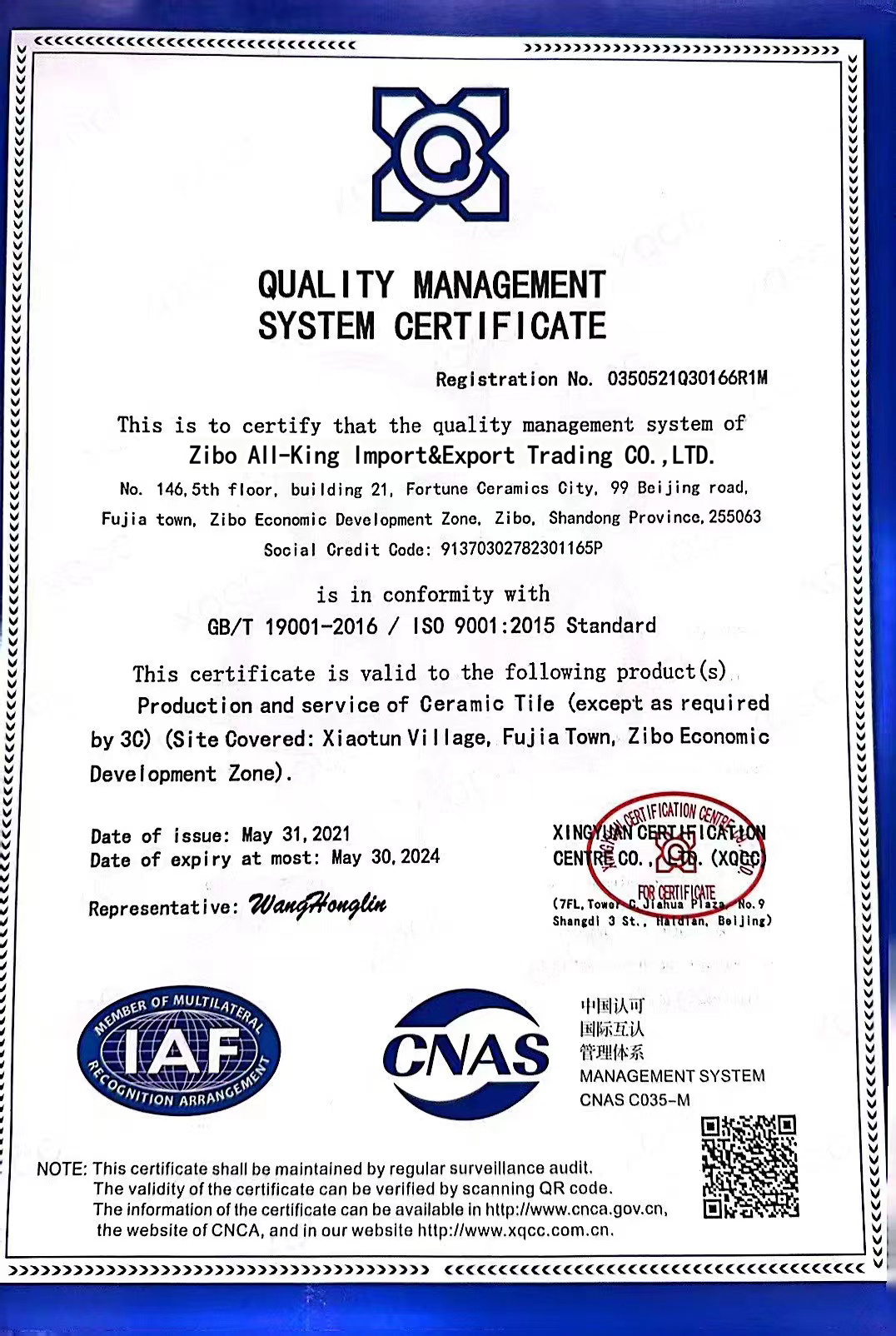
ISO 9001:2015 - The Management-System Path
- Certificate number: 0350521Q30166R1M
- Standard: ISO 9001:2015
- Issuing body: XQCC
- Market applicability: Global Markets
- Certified scope: Production and service of Ceramic Tile (except as required by 3C)
- Products listed: 4765 Marble Series, 5624 Travertine
The XQCC certificate describes the system that produces the tile, not the measured performance of a batch. For a project buyer, that means predictability: it supports the control regime behind the shipment, which at ALL KING CERAMICS includes 100% flatness and sizing auto-check, piece-by-piece visual inspection, and random lab testing per batch. It also supports multi-phase projects, because batch tracking and reordering support let a later phase match the first delivery. The limit sits in the scope sentence itself: the certificate is written for production and service, with an explicit carve-out for what 3C regulates, so it is not a product-conformity document for any specific market.
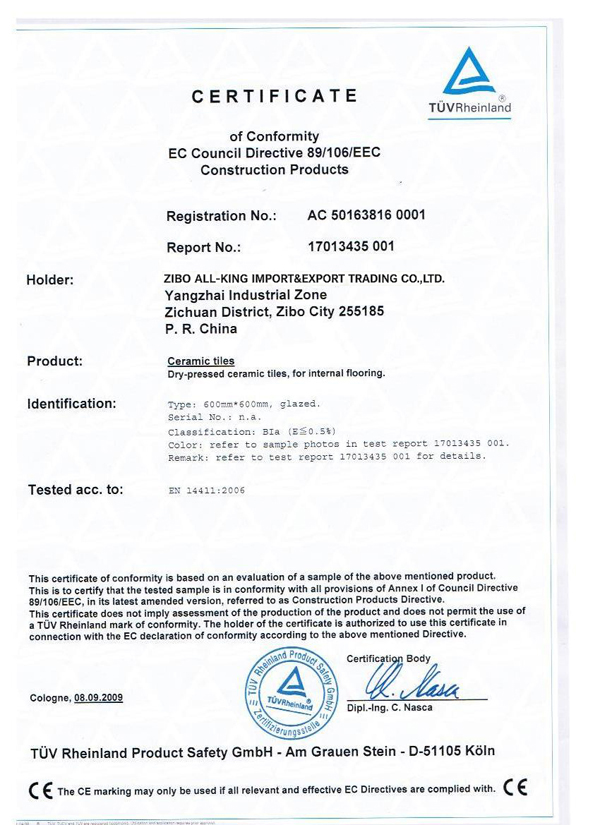
CE - The Product-Conformity Path
- Certificate number: AC 50163816 0001
- Issuing body: TUV
- Applicable standard: EEC
- Market applicability: EU
- Certified scope: Ceramic tiles - dry-pressed ceramic tiles, for internal flooring
- Products listed: 4765 Marble Series, 5624 Travertine
This is the document a EU-facing contractor, importer or authority expects against the delivered product. It is narrower than a factory certificate in one important respect: it names a product construction (dry-pressed ceramic tiles) and an intended condition (internal flooring). The limit is therefore a wording limit, not a quality limit. Outdoor pavers, external walkways, pool surrounds and facade elements are not described by that sentence, so if those areas are in the project, the evidence question must be settled at specification stage rather than at delivery.
Where the Scope Sentence Decides the Project
Put the two scope statements side by side and the decision framework appears. The ISO 9001 scope is an operational statement about production and service, with a 3C carve-out, and it applies to global markets. The CE scope is a product statement about dry-pressed tiles used as internal flooring, and it applies to the EU market. Neither sentence is broader than the other in a general sense; they are broad and narrow in different directions.
Practically, a EU shopping mall interior, hotel lobby, hospital corridor or school floor falls inside the CE wording without discussion. A project that includes 20mm outdoor pavers, an external terrace, a pool deck or facade cladding moves part of the scope outside that wording, and the buyer should confirm with the project authority what evidence will be accepted for that portion before the order is priced. A project outside the EU is not gated by CE at all, so ISO 9001 plus the technical specification and slip classification usually do the work, with CE supplied as additional assurance.
Where the Certificates Attach: Product 4765 and Product 5624
Both certificates list the same two product codes, which removes the most common documentation mismatch in project orders. Product 4765 is marketed as Marble Series, and product 5624 as Travertine. Both are 60x120cm porcelain tiles, the flagship format at ALL KING CERAMICS, alongside 60x60cm, 80x80cm, 100x100cm and 75x150cm formats in the wider matrix.
- Thickness range: 9.0 to 10.5 mm
- Water absorption: below 0.5% (vitrified)
- Abrasion resistance: PEI 4 / PEI 5
- Mohs hardness: 6 to 7
- Breaking strength: at least 1300 N
- Modulus of rupture: at least 35 MPa
- Packing: 2 pcs per box, 1.44 m2 per box
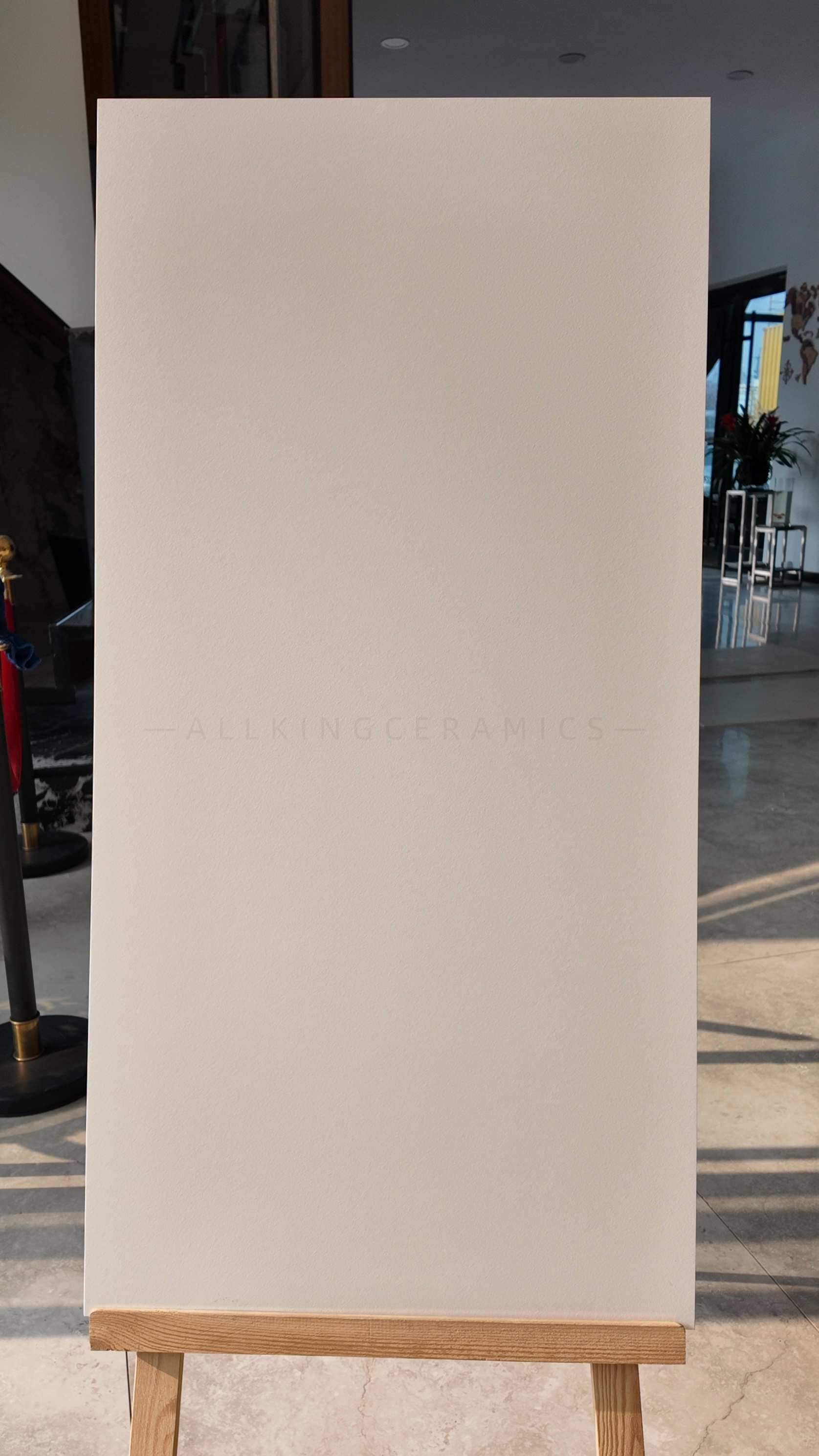
Because the certificate is tied to the product code rather than to a factory in general, the code is the item that must travel through the whole chain: sample label, quotation, PO line, packing list and acceptance file. A buyer who cannot point to 4765 or 5624 in the certificate pack has a documentation gap even when the certificate itself is valid.
Step-by-Step Breakdown: Choosing the Right Path in Seven Moves
- Fix the destination market and the acceptance authority. Determine whether the tile is being placed on the EU market, and who signs off acceptance. That single answer decides whether CE sits on the acceptance line or in the supporting file.
- Map the installation area against the CE scope wording. Internal flooring is inside the sentence. Outdoor pavers, terraces, pool decks and facade elements are not. Mark each area of the project as inside or outside.
- Assign document roles. CE as product conformity for EU delivery; ISO 9001 as management-system evidence for supplier screening, second-source approval and multi-phase continuity. State both roles in the tender response so no evaluator has to guess.
- Pin the certificate to the product code. Confirm that 4765 (Marble Series) or 5624 (Travertine) appears on the certificate you are submitting, and write the certificate number on the PO line.
- Build the technical pack around the certificate. Attach the specification sheet: 60x120cm, 9.0 to 10.5 mm thickness, water absorption below 0.5%, PEI 4 / PEI 5, Mohs 6 to 7, breaking strength at least 1300 N, modulus of rupture at least 35 MPa, 2 pcs per box at 1.44 m2 per box, plus the anti-slip classification the area requires.
- Agree the batch acceptance criteria. Write down what will be checked: flatness and sizing, visual inspection, random lab testing per batch, and the slip class. These are the points that make a certificate useful at handover rather than only at shortlisting.
- Lock commercial terms around the compliance path. MOQ is 400 sqm per design with trial orders acceptable, lead time is 7 to 10 days, and monthly capacity is 1.2 million m2. Agreeing these after the certification decision avoids re-quoting when the scope changes.
Use Cases: Where the Decision Shifts
EU retail and mall interiors. CE governs. The project sits squarely inside dry-pressed ceramic tiles for internal flooring, and 4765 or 5624 with PEI 4 / PEI 5 abrasion resistance and breaking strength at least 1300 N matches continuous commercial traffic. ISO 9001 is filed as supplier evidence.
Hotel lobbies and high-traffic corridors outside the EU. ISO 9001 plus the technical specification do the primary work, because CE is not the legal gate. Large-format 60x120cm tiles with water absorption below 0.5% and Mohs hardness of 6 to 7 suit lobby floors where appearance retention matters as much as wear resistance.
Healthcare and education projects. Both documents are usually requested together: CE if the building is in the EU, ISO 9001 as system evidence everywhere, plus the slip class. R11, defined under DIN 51130 as grip on an oil-wet inclined plane between 19 and 27 degrees, is the level these specifications commonly reach for. Porcelain tile also carries the LEED VOC exemption because kiln firing destroys organic matter, which is relevant where a green-building credit is claimed.
Mixed developments with indoor and outdoor zones. This is where scope reading matters most. The interior portion follows the CE wording; the outdoor pavers, terraces and pool surrounds fall outside it, so the evidence route for those areas should be agreed with the project authority during specification, not after delivery.
Private-label and OEM distributors. Custom size and thickness, surface finish, brand logo and packaging, marble vein variation and anti-slip rating are all available, and the certificate still attaches to the underlying product code. OEM cartons and branding must therefore preserve traceability back to 4765 or 5624, otherwise the certificate pack no longer matches what arrives on site. Company records reference commercial orders of around 15,000 sqm across hotel lobbies, mall flooring and airport departure halls.
Comparison Table: ISO 9001 vs CE at ALL KING CERAMICS
| Decision point | ISO 9001:2015 | CE |
|---|---|---|
| Document type | Quality management system certification | Product conformity certification |
| Certificate number | 0350521Q30166R1M | AC 50163816 0001 |
| Issuing body | XQCC | TUV |
| Standard referenced | ISO 9001:2015 | EEC |
| Market applicability | Global markets | EU market |
| Scope statement | Production and service of Ceramic Tile (except as required by 3C) | Ceramic tiles - dry-pressed ceramic tiles, for internal flooring |
| Products listed | 4765 Marble Series, 5624 Travertine | 4765 Marble Series, 5624 Travertine |
| Governs in the purchase order when | Supplier screening, second-source approval, multi-phase continuity | EU delivery and product acceptance on internal flooring |
| Not a substitute for | Product conformity for a specific regulated market | Management-system evidence of factory control |
| Typical project moment | Shortlisting, factory approval, framework agreements | Customs, importer due diligence, handover documentation |
Read the table in one direction only: pick the row that describes your acceptance authority, then confirm the product code on the certificate. When both rows apply, which is the normal case for an EU project sourced from a new factory, submit both and label each one by role rather than presenting them as alternatives.
Frequently Asked Questions
Does CE certification replace ISO 9001 for a EU porcelain tile project?
No. CE certificate AC 50163816 0001 issued by TUV covers product conformity for the EU market and is scoped to dry-pressed ceramic tiles for internal flooring. ISO 9001 certificate 0350521Q30166R1M issued by XQCC certifies production and service of ceramic tile for global markets against ISO 9001:2015. A buyer verifying product conformity uses CE; a buyer verifying that the factory runs a certified production and service system uses the XQCC certificate. Both are held for products 4765 and 5624.
Can the same 60x120cm tile be delivered with both certificates attached to the order?
Yes, for the two codes named on both documents. Product 4765 (Marble Series) and product 5624 (Travertine) appear on the CE certificate and on the ISO 9001 certificate. Both are 60x120cm vitrified porcelain tiles with thickness of 9.0 to 10.5 mm, water absorption below 0.5%, PEI 4 / PEI 5 abrasion resistance and breaking strength of at least 1300 N. The certificate numbers should be written on the purchase order so the documentation can be matched at delivery.
Does choosing between ISO 9001 and CE change the cost of a porcelain tile order?
The two certificates are already held for 4765 and 5624, so selecting either document path does not add a certification step for those products. What moves commercial terms is format, surface finish, anti-slip customization (R10 and R11 are standard, with R12 achievable through customization), OEM logo and packaging, and order volume against the 400 sqm per design MOQ. Where a project needs conformity evidence for an area outside the CE scope wording, such as outdoor paving, that question belongs in the specification stage so it can be reflected in the quotation rather than discovered at acceptance.
Can certification be verified before samples are approved?
Yes, and it should be. Request the certificate copies with their numbers, 0350521Q30166R1M for ISO 9001 and AC 50163816 0001 for CE, and match them against the product code shown on the sample label. Samples are packed 2 pcs per box at 1.44 m2 per box, and trial orders are acceptable, so a buyer can run a small batch through the specified checks before committing to full volume. Production control covers 100% flatness and sizing auto-check, piece-by-piece visual inspection, and random lab testing per batch.
Once the certification path is agreed, how quickly can material ship?
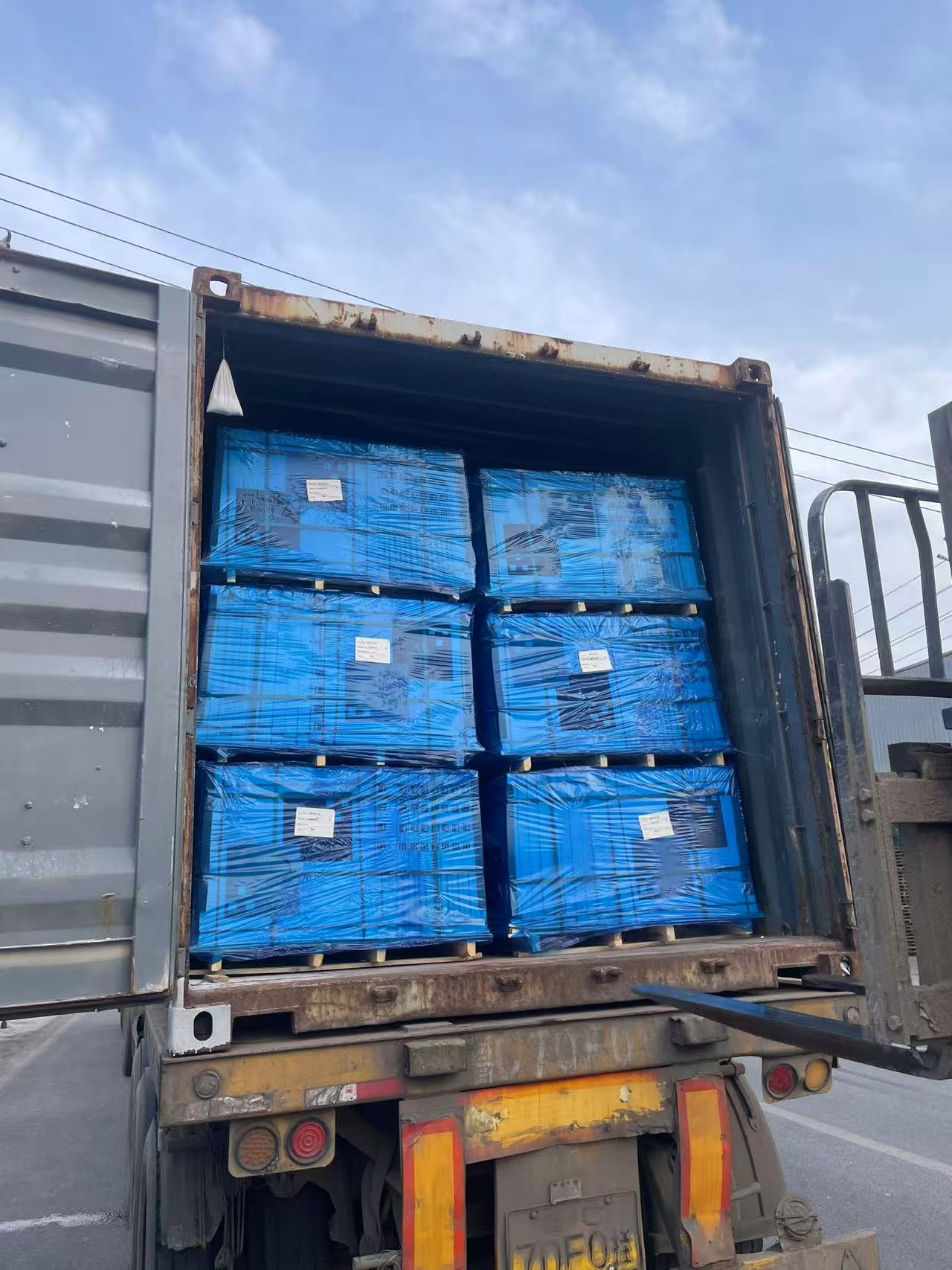
Lead time is 7 to 10 days, supported by a monthly capacity of 1.2 million m2 and annual output of 12 to 16 million m2. MOQ is 400 sqm per design with trial orders acceptable, and after-sales support includes batch tracking and reordering so later phases can match earlier deliveries. To move from document review to a decision, request the certificate pack, a product sample of 4765 or 5624, and a project-specific quotation through tyceramic2@all-king.com, or review specifications in the ALL KING CERAMICS catalog.
Next Step: Match the Certificate to Your Project Before You Order
Send the destination market, the installation areas and the product code you intend to specify. ALL KING CERAMICS will return the matching certificate copy, the technical sheet for 4765 or 5624, and a sample arrangement for approval. Contact Abby at tyceramic2@all-king.com, call or message +86 156-5336-9360, or download the catalog from the ALL KING Ceramics catalog. Company details are available at www.all-king.com.
Conclusion
The head-to-head resolves into a division of labour rather than a winner. CE certificate AC 50163816 0001 from TUV is the document that lets a dry-pressed porcelain tile be accepted as internal flooring on the EU market. ISO 9001 certificate 0350521Q30166R1M from XQCC is the document that shows the factory runs a certified production and service system for global markets. Choose CE when the acceptance authority is in the EU and the area is internal flooring; choose ISO 9001 when the question is whether the supplier can repeat a batch, absorb a second phase, or pass a contractor screen.
Two practical rules close the gap. First, always attach the certificate to the product code, and for this supplier that means 4765 (Marble Series) or 5624 (Travertine), not a general factory statement. Second, read the scope sentence against the installation area before pricing, because internal flooring and outdoor paving are different evidence problems. A buyer who applies both rules gets a documentation pack that survives shortlisting, import and handover without being rebuilt at each stage.
Have Questions or Need More Details?
Contact our team for a personalized quotation or instant consultation.
Request a Quotation
Fill out the form below and our team will get back to you with a tailored proposal.
WhatsApp Direct Chat
Prefer to chat in real-time? Message us on WhatsApp for instant assistance & quick answers.
- Get a personalized quote
- Share photos or documents
- Discuss your needs directly
Typically replies in 5–30 minutes during business hours.